Avoiding tax avoiders
 The UK Labour Party is under pressure, apparently, because big business is not endorsing tax policies. The most recent criticism has come from Stefano Pessina (left) the boss of Boots, the iconic British pharmacy-cum-drug store. Boots was founded in Nottingham, England, in 1849. It is now privately owned and has its headquarters is in Zug, Switzerland, to avoid UK corporation tax.
Now out of the woodwork are the fickle Simon Woodroffe, he of Yo! Sushi fame, who has funded both Labour and the Conservatives simultaneously just to hedge his bets, and Charles Dunstone, founder of Carphone Warehouse, now part of the Dixons empire. Both of these supported Labour under Blair. Arguably, Labour under Blair was conservative, and hence not a risk. Actually it would have been a risk not to support them in the run up to the 1997 election. Even Murdoch did that.
Labour under Miliband has targeted inequality as a key economic factor much to the chagrin of so-called ‘business leaders’ who took us in to recession and are unwilling to contribute to the state infrastructure that enables them to trade in the country safely and predictably.
Enter Price Waterhouse Coopers (PwC) the accountancy firm has been chastised by the UK Parliament’s Public Accounts Committee, Chaired by Margaret Hodge, for its speciality in advising firms on tax avoidance strategies on an ‘industrial scale’. Denied, of course.
Which other firms offend? We know well about Starbucks, Facebook, Top Shop, Amazon, Google, Apple and Virgin. That said, it is ok for Richard Branson because he is a philanthropist. Maybe we can define a philanthropist as someone who gives away part of their fortune to rectify the ills caused by their own business practices?
Other tax avoiding firms include: Dyson and Wolseley UK, owners of Plumb, Pipe, etc, Centers.
Celebrities have always moaned about tax. Michael Caine went off to the US, albeit when tax rates were somewhat higher than they are today (but even then, the high rate was a marginal rate). Unfortunately, Paul Daniels did not go when he threatened to back in the 1990s, let us hope that the likes of Griff Rhys Jones and Ray Winstone do leave as they threaten. Gary Barlow, Anne Robinson, the Arctic Monkeys, Katie Melula, George Michael and comedian, Jimmy Carr (I could go on) have all been exposed as intentional tax avoiders.
Picture: Stefano Pessina – Alliance Boots, available through Wikipedia
Pall Mall and mature couples
 Is this the new Pall Mall couple? The ageing hipster with his oh-so stylish beard. The 30 something woman with perfect teeth and nail-barred fingers wonderfully hosting a newly lit cigarette. And the strapline? Erm…more is not enough for us?
Is death not enough?
Syriza and the Greek response to austerity
Filed under: Finance and Economics, International, Politics |
 Leave a Comment
 Increasingly, it is clear that globalisation has globalised wealth in the hands of a number of elites – from  oligarchs in Russia, bankers in the UK and land speculators in Bombay. When the crash came in 2008, the perpetrators – the financial services elites – ‘hoovered’ up the public money pumped into the system to obviate a capitalist meltdown. No one went to jail; but Europe’s people were handed down a dose of austerity in return for their support. What is perplexing is how any sane policy-maker can sustain an argument that austerity helps declining economies. In Greece, for example, something in the order of 70 per cent of the country’s under 25s are unemployed. They are neither economically active nor productive. In the UK, unemployment goes down not because the economy is growing and the demand for labour is increasing; rather because people are taking zero-hour jobs or, indeed, taking jobs for an hour through ‘freelancer’ websites. Or, most disturbingly, if unskilled – at the unconnected end of the labour market – ads in supermarkets and shop windows.
Syriza’s victory in the Greek general election last week represents something positive. It is populist, but from the left rather than the right. The rhetoric is one of alternative, fairness and equality. It is a David and Goliath story in the making. The new Greek Prime minister, Alexis Tsipras (left), takes his secular oath, appoints radicals to his government (such as Yanis Varoufakis as Finance Minister), halts privatisations, reappoints the cleaners who were sacked from their jobs in the finance ministry, initiates tax reform and targets corruption. They have even put up all of the ministerial BMWs up for sale.
https://twitter.com/Oireachtas_RX/status/561578575057666048
We learn that the first port of call is not the IMF, the European Commission or even the German government in Berlin, rather opposition parties in Italy and Spain – next up on Europe’s election merry-go-round. I wait and see what happens, but there is optimism about Europe’s prospects and the rightness of Syriza’s approach to the crippling debt that they have inherited. I trust the elites do not share my optimism.
Flag: Fry1989, Wikipedia
Photo:
An outsource too far?
 I was casually scanning the pages of the Guardian newspaper yesterday and came across a link to a story that suggested that John Lewis, the co-operatively-owned department store with a reputation for excellent customer service, has been outsourcing some of this activity to decidedly dubious third parties with potentially disastrous results.
Firms outsource, ultimately, to save money. Listed firms to this to maximise the return to their shareholders. It is the logic of capitalist business. But John Lewis is supposed to be different. Its owners are its employees, though its management is most certainly professionalised (in contrast with the Co-operative group which is now in some financial difficulties after gross mismanagement by amateurs).
So, to which outsourcing companies has John Lewis entrusted its reputation? When I discovered the identities of said firms, I needed a sharp intake of breath. Wait for it…Hermes couriers, who pay between 45 and 55 pence – PENCE – per delivery to self-employed delivery people, and Capita who seem to handle John Lewis’ complaints.
I have already ceased trading with firms that use Hermes. The service is appalling, for sure. But it is the business model that stinks. Whilst it is possible to avoid this by picking up ordered items at John Lewis and Waitrose stores, handing over any money to these charlatans is bad for society. It legitimises them.
Finally some good advice from Marlboro
 The Marlboro ‘Maybe’ campaign is back on the streets of Munich and presumably the rest of Germany. Much missed, I have to say. For once, it seems, the statement has something going for it. I am learning myself how to do this consistently. ‘Maybe’ it is a function of age? ‘Maybe’ a function of maturity?
Linking it with cigarette consumption, however, is not quite such a positive. ‘Maybe’ it will just be ignored. ‘Maybe’.
Apple’s cash mountain
 I am not an Apple fan. I do not like the design. I do not even like the font they use on their iOS interface. I hate the hype. But the results announced last week suggest I am in a minority. Apple reported profits of $18bn for the third quarter of 2014 generated by selling 34,000 iPhones per hour for the whole of that quarter. Mind boggling.
Apple now sits on a $180bn cash pile, a good amount of it is stashed in a bank account in Ireland selected so as to avoid paying tax on it in the United States of America. Good citizenship if ever I saw it.
So how does Apple reward its shareholders – ultimately the owners of the company? Well, apparently, according to the BBC’s Ian Jack (his explanation can be heard below), Apple is borrowing money in order to buy back its own shares so that shareholders pay a lower tax rate – capital gains tax rather than income tax.
It has been pointed out by the likes of Mariana Mazzucato in her book The Entrepreneurial State that, notwithstanding the immorality of avoiding paying tax, buying back shares also diverts money away from investment in new products, processes and technologies. Essentially, these companies not only avoid paying tax in the countries where they trade and/or are based, but they also get subsidised by the public sector through universities that make up the shortfall in basic research that should be done by the firms that utilise that research for new products and services. A double injustice.
Here’s the next challenge to our liberties
Filed under: Environment, International, Politics, Privatisation |
Leave a Comment 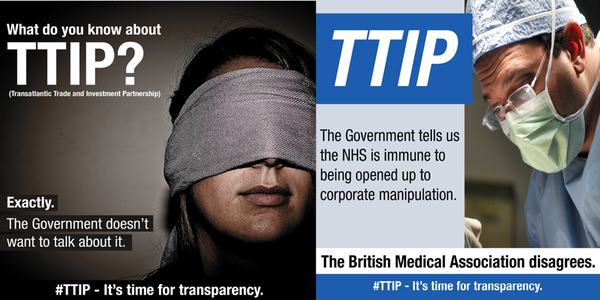 So here is the next outrage – the inappropriately named Transatlantic Trade and Investment Policy, coming to a court not near you very soon. It is inappropriate because it is not really a trade and investment policy. Such a policy would, on the whole, be benign. This one, by my understanding, gives large corporations the opportunity to challenge nation states/governments on issues that they view as restrictions on trade. So, a nationalised health service is conceivably a restriction on trade of US healthcare providers. Under this argument, US corporations would be able to make the case that they should be able to compete for contracts in the NHS – the whole of the NHS, not just the bit that the UK Conservatives have so far transferred to their private sector firms. Equally, all environmental policy could be viewed in this way. Restricting carbon emissions, for example, imposes costs on firms, that is a restriction on trade. Surely corporations should be able to pollute as much as they like?
Camel’s spring push
 Camel seems to push its brands in January and February in Germany. The brand is sharing the approach of Marlboro, JSP, Pall Mall and others – focus on the brand, two varieties, clean packaging an asinine strapline. In this case, “Camel unplugged” captures that approach coupled with the familiar “Geschmack ohne verstärker” – essentially taste without additives, if my translating skills are in tact.
This campaign is clearly a winner because that august publication, the Cigar Journal, has verified the taste claim having compared 36 similar products. So there you have it. See you in hospital.
New year smoke
 There is not much interesting happening on the cigarette advertising front at the moment in Germany. All to report is that JSP has claimed a few vacant advertising hoardings and come up with the amazing offer of “extra for you”. This prompts me to say my usual – extra tar, carcinogenic chemicals, death. Happy new year.
Ched Evans – rape and re-habilitation
Filed under: Business, Journalism and News Reportage, Sport |
Leave a Comment  I was not going to comment about this case. I’m not particularly qualified in terms of the law and the crime, but three things in particular have prompted this post. First, some background for readers not familiar with the case. Ched Evans was a footballer for Sheffield United, a third league club in England. He was convicted of rape in 2011 and sentenced to 5 years imprisonment. He served half of his sentence and is now ‘out’ on licence and seeking to relaunch his football career. It is clear that his old club was keen to take him back, but sponsors pulled out and the negotiations ended. Oldham football club then took up the case and was offered guarantees against losses incurred if sponsors pulled out by Evans’s future father-in-law, Karl Massey, a rather wealthy businessman. That has now fallen through after pressure on the club and its employees. The precise details are unclear. Evans insists he is innocent of rape. He had not offered apologies to his victim whose identity has apparently changed 5 times since the crime. Since the Oldham contract fell through, Evans has now apologised for the effects of his actions, but still protests his innocence. Then yesterday some extraordinary things happened. First, Gordon Taylor, the head of the Professional Footballers’ Association – the trade union for footballers – likened the case, wrongly, to victims of
  the Hillsborough disaster where 96 people were crushed to death because of police incompetence and then blamed for it after a police cover-up. Taylor has since apologised. Then the Manager of my club, Steve Bruce (right), inexplicably waded in saying that he had looked at the evidence himself and he thinks that there is a case for appeal. Mr Bruce, Hull City are in trouble at the bottom of the league. Concentrate on that, and leave well alone of Ched Evans. And then to make matters worse, a so-called academic – wrongly claiming to be from my university – engages on a debate on the issue and not only advocates for Evans but also says that people from ‘lower classes’ are more likely to engage in criminal acts. On the former he is quoted as saying in the Argus newspaper “it would be ridiculous to allow the conviction to ruin Evans’ career”. All of these three men have one thing in common. They do not get it. At the very least, can I suggest all three listen to the clip from BBC Woman’s Hour. And then listen to it again. I’m not a great fan of Hadley Freeman from the Guardian, but this is as good an exposition as I have heard or read.
. Pictures: top – screen grab from Woman’s Hour website; Steve Bruce:
 Be informed