Justifying the unjustifiable
Filed under: Politics, Race | Tags: Mediterranean Migrants, Theresa May
 Leave a Comment
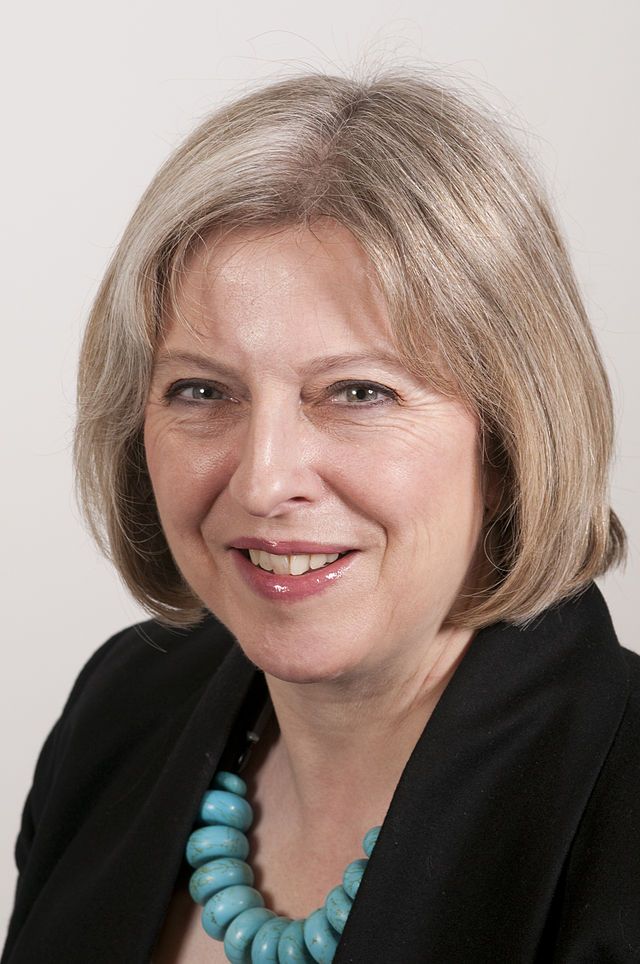 The UK Conservatives now argue that too many people – cast out on to the Mediterranean Sea in unsuitable boats by unscrupulous traffickers – have been saved by benevolent Europeans. So much so that it generates an incentive for more people to try it, safe in the knowledge that they will be rescued when the vessel capsizes.
Even if this were true – and no hard evidence to my knowledge has been presented to back it up – it is immoral. Knowingly ignoring victims of traffickers, fleeing from wars, economic crises and penuary caused largely by us is criminal.
And again, leading the way is the Home Secretary, Theresa May (above left). I used to think that these illiberal and racist policies were a response to UKIP. Now, however, I sense that UKIP is merely an excuse. The Conservatives really do believe in these policies.
Privacy and the Internet
 The new boss of GCHQ, Robert Hannigan, this week wrote a much-reported article in the Financial Times arguing that in order to stay safe we must give up our [right to] privacy. We must accept blanket surveillance of our online communications. He is frustrated that the large US tech firms that dominate the social media world are uncooperative. Consequently they are the ‘command and control networks of choice’ of international terrorists and paedophiles.
Well, he would say that, wouldn’t he? Here is a man whose job it is to do communication surveillance. In recent years – and certainly since Snowden – its legitimacy has been questioned. We may have asked, ‘in whose interests is this surveillance’? And if it is for us – citizens – then how would we know? We are never given the data that would tell us how effective it is in preventing attacks or the abuse of children.
Now, Mr Hannigan (right) has asserted that all of CGHQ’s surveillance is undertaken to protect us against attack from whomever or whatever. Again, there is no evidence that surveillance protects us, but the security services remain powerful arms of the state. The more surveillance they do, the more money they get. The more they convince us that only more surveillance can protect us – and we believe it – the more resources they will command and the less free we will be. And bearing in mind they tell us that surveillance is needed to keep us free, one wonders what kind of freedom they have in mind.
Naturally, the ‘if you have nothing to hide you have nothing to fear’ argument still resonates. But as Martha Lane Fox – one time government-appointed Tsar for digital inclusion and founder of lastminute.com – and anything but a crazy libertarian – said through a number of new and old media yesterday, “I would not want GCHQ to come and rummage in my front room and that is how I feel about whatever device I am using”. Moreover, the security services already have significant powers to investigate communication, not least through DRIP which a subservient UK Parliament rushed into law before the summer recess in 2014. Again, at the behest of the security services.
But what these people really dislike is the idea that ordinary people can encrypt their own communication. On the whole, our communication is unencrypted. The devices that we use are easily accessible to outside forces (with a few exceptions, notably Blackberry handsets). When we download an app we invariable sign away privacy in order to use it. But I do feel that I – and others – have a right to privacy and that the security services have enough power already to investigate any wrongdoing on my part. But they do need, first, to have sufficient evidence to get the warrant to invade my privacy. They are not the rights holders. We are.
Picture: GCHQ – MoD; Robert Hannigan – gov.uk
Rochester by-election – UKIP and neo fascists, Britain First, stand together
Filed under: Politics, Race | Tags: Britain First, Rochester and Strood, UKIP
Leave a Comment 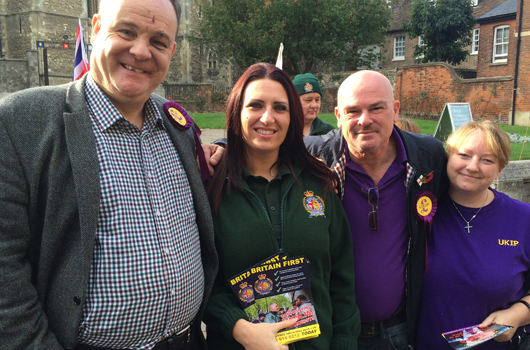 The Rochester and Strood by-election was caused by the resignation of the incumbent Conservative, Mark Reckless, as a result of his defection to UKIP. The by-election is an opportunity for any number of disgruntled people to stand for election. By-elections – particularly towards the end of a parliamentary period – often throw up surprises. Probably not enough to elect Britain First’s candidate, Jayda Fransen. Never mind, she seems quite friendly with UKIPers if this happy photo is anything to go by. Might they have much in common?
Picture: Britain First website
Spectacle Hut being crass
 This is Spectacle Hut in Hastings, UK. Nothing special, just one of those high-street opticians. They are open 7 days a week and there are eyesight test appointments available on Sundays. And how do we know this? Well through a crass poster (right).

Now I’m an atheist and certainly no friend of the Catholic Church; but this is just insulting. Put a fully made-up model in a nun’s habit and hey presto, point made. Spectacle Hut, if you are going to stoop this low, at least use a real nun.
UKIP and health tourists
Filed under: Politics, Race | Tags: Malala Yousafzai, Nigel Farrage, UKIP
Leave a Comment Nigel Farage, the leader of the United Kingdom Independence Party said, in the aftermath of his party’s victory in the Clacton bi-election (remind me not to go there), that we should prevent people with HIV (as a proxy for all people with an illness) from coming to the country. Clearly they will make a huge call on the NHS and we should exclude them.
I find these opinions reprehensible. However, I found it ironic that on the very same day (10 October 2014), the Nobel Peace Prize was  awarded to Malala Yousafzai, the young woman who was shot by the Taliban in Pakistan for standing up for her right to an education. After her condition stabilised she came to the UK for specialist treatment in Birmingham (and where eventually she continued her education). Now I do not know if she had private health insurance…
Picture: /Wikipedia
Autumn smoking
Filed under: Cigarette advertising | Tags: Don't be a Maybe, marlboro, Pall Mall
Leave a Comment  Pall Mall’s Autumn campaign is not really anything to write home about. The packs (left) basically say, “look at me”. But what does it really mean to be a limited edition cigarette; and more bizarrely, to have unlimited taste? Surely they mean lots of carcinogenic burnt tobacco taste that burns one’s tongue and lingers longer than rivals’ brands? Or some such.
Marlboro’s Endurance Man campaign is a little clearer after the arrival of the new poster (right). Endurance Man here has a motorbike, though he remains inexplicably riding across the desert in search of a tobacconist.
Post holiday blues in record time – European Convention on Human Rights
Filed under: International, Politics | Tags: Chris Grayling, European Convention on Human Rights, Theresa May
Leave a Comment It does not take long for an awful reality to reassert itself after the summer tandem riding holiday, even if it was un-summerly and not everyone’s idea of a holiday. For example, what on earth happened in Scotland? Why did the Scots vote to stay dependent on the English elite establishment, fronted by David Cameron. One wonders whether the result would have been different had the Tory Party conference occurred before the vote rather than after it.
 It was, of course, at that conference that Chris Grayling, the UK (in)Justice Secretary, announced that should the Tories win outright the next UK election, they will knowingly take us out of the European Convention on Human Rights so as to free the country from those pesky European judges who so often tell us to do things that we do not want to do, such as give votes to prisoners, allow foreign criminals into the country, prevent the extradition of undesirables (especially those with hooks as substitutes for hands) and a ban whole-life sentences for grave crimes. It does, of course, none of these things; the Strasbourg Court merely highlights incompatibilities between UK law and the Convention. See: http://www.tinyurl.com/pszhdky
But instead, we will have a UK Bill of Rights, subject to the whim of the Tory elite to decide whether any citizen’s claims of a breach of human rights is valid or not. Not independent judges, but the likes of Grayling himself. Moreover, this elite used their conference to inform us that we have to allow ourselves to be subjugated, monitored and pacified to maintain security against the threat of terrorists that the elite has created for us through innumerable foreign wars, murder, incarceration and expropriation. The Home Secretary, Theresa May (right), told the conference that the ‘snoopers’ charter’ will be reintroduced to Parliament and passed when there is a Tory majority; but of course one has nothing to fear if one has nothing to hide.
The European Convention is not an EU institution, however. The Convention was scripted by European human rights lawyers, many of them British, in the early 1950s in the aftermath of WWII. To withdraw is to align ourselves with some of the least liberal states in the world; for example, Belarus.
 Such a move will precipitate a response from the Council of Europe – which is an EU institution. Ultimately, adherence to the Convention is a reasonable condition for membership of the European Union, if not the United Nations. Of course, getting out of the EU is precisely what Tories want and these arguments play well with their illiberal supporters. It is always gratifying to hear that the Prime Minister is generously giving our European partners one more chance to see sense and allow the UK to contravene the founding treaties that enshrine the concept of the free movement of people across European borders. A right that millions of UK citizens have exploited over the years.
Pictures:
Theresa May: ,Wikipedia
European Court Strasbourg: CherryX, Wikipedia
Tandem Tour 2014: Lommel to Maastricht
 This is a ride for people who like flirting with national borders; in this case between Belgium and the Netherlands. It is rural and navigated by long avenues and canals. The route takes riders across the border, I presume, in order to visit the historic town of Thorn (below right). It is called “the White Town”; seemingly, there are 105 protected white houses in the town. The church is also impressive. It is a good place for lunch, too.

After Thorn, it is back into Belgium and due south towards Maastrict. En route riders pass through Maaseik. Maaseik boasts a large central square (below, left) a museum and a couple of churches. It is the birthplace of Flemish painters Jan and Hubert van Eyck whose  statues are in the central square.
It was late afternoon when we left Maaseik. We refuelled with ice-cream and burned it off along the Zuid Wilemsvaart (canal) and crossed the border again at Smeermaas. In search of hotels on the approach, we ended up in the main square, Vrijthof, that was hosting the annual raucous food festival. The raucousness came from the huge volumes of alcohol being consumed after the eating. Despite that, we found a quiet room in the adjacent Hotel Du Casque.
Maastricht is busy. The shopping streets on the western side of the river are largely car free. There is not much that is unique from any other significant town across Europe with the possible exception of the Boekhandel Selexyz Dominicanen (bookshop) in an ancient (1294) Dominican church (right).
 The east side, however, is modern but conversely more eclectic. It is home to the fantastic ceramic centre (left; when staying in Maastricht, visitors pay tax on hotel rooms for all of the museums and some public buildings like this one). There is some exquisite pottery inside to view. There is also some peculiar items like the tank teapot (right).

It is also home to the ‘drogerie’ with the most wonderful window  display and a vegetarian restaurant as good as any (left). And not forgetting the railway station with its ceramic sphinx (below right).

Tandem Tour 2014: Quirks
| Brugges: the Wash Casino. Erm…casino, betting, gambling, chance, losing money, uncertainty. Or winning…other people’s laundry in a winner-takes-all situation. I think this may be a launderette to avoid? |  |
 |
Maaseik – lamp-posts that double up as speakers pumping out ‘easy-listening’ music. |
| Maastricht – the perfect shop window? |  |
 |
Public toilets are always at a premium when travelling. We took refuge in a park for lunch where some retired people were playing boules. The unmarked white box had to have some purpose. Low and behold, there is it was. A fully functioning flush toilet. |
Tandem Tour 2014 – Ghent to Lommel
 I have often heard the mantra that providing that one wears the right clothes, the weather should not matter. Those who say this either have a budget beyond mine and are supplied by NASA or they never really experience a full day of heavy rain on a bicycle. We exposed ourselves to a full seven hours of riding in increasingly heavy rain in order to reach the small town of Boom, 110 kms east of Ghent.
This is river and canal riding at its best. The river is the Schelde and it becomes increasingly imposing and navigable. The Schelde does not actually flow through the centre of the city, but the cycle route joins it at St Amandsberg. There is a fantastic moment riding along where one has one of those, “do you see what I see?” moments (right). It is an old Sabena airliner that has come to rest in a factory yard.
 There are two occasions on this stretch when the path takes riders over the river by ferry. Our experience in Germany is that ferries just, as-and-when, cross the river between set hours in the day. This is not so in Belgium, at least on the Schelde. Seemingly, they run a half-hour service. But more importantly, they can be requested. On two occasions, the ferryman, saw us waving (it was raining after all) and immediately collected us. The ferries are passenger ferries only. And they seem to run between places that are not exactly centres of population. They are also free (though the ferrymen were delighted to receive a good tip). What’s more, one finds the ferries bunched in pairs – situated perhaps a couple of kilometres apart. Essentially, they are operated by one man.
 So we crossed the river at Mariekerke (left) having been unable to work out how to get the ferry across to nearby Sint Amands. Mariekerke is nothing more than a village, but it did have a welcome Gasthaus where we could get some hot food and warm up a shade. In fact, it was fantastic. It was a Monday afternoon and the place was hosting an afternoon lunch for a group of elder burgers. They were having a ball. And cared not a jot for us.
The second crossing was a little more complicated. The Schelde is joined by the Rupel, adjacent to both is a busy canal (Zeekanal) with a series of locks. Finding a closed gate that was crossable took us a little while. And then came the ferry. We flagged it down, it came, we went across. At the other side the path to the left goes to Schelle (and Antwerp) and right to Boom. Boom was our preferred end point for the day. And we found the only hotel in town.
Another full day of rain was forecast, so we decided to stay on for a second day and take the train to Antwerp. Wise, in many respects. Architecturally it is magnificent, and the magnificence starts with the railway station that is more like a church than a railway terminal (right) . There is a hierarchy of lines – the intercity trains depart from the ground level; regional trains for floor -1; and the trains to Boom from -2!
Antwerp is the home town of Peter Paul Rubens, the celebrated 16 Century artist. His paintings are everywhere, not least in the churches dotted around the city. His house, where he retreated  after his prolific and highly lucrative years with his bride who was considerably younger than him, can easily be found. I’m not sure why we did not visit, especially being so wet. Instead we wandered around and visited the old town and waterfront (left).
It was back on the bicycle to Lommel the next day. The sun was shining and the rest day had been welcome. Bearing in mind our final destination was Aachen, the logic of going to Lommel was not strong other than it being the recommended route. The route continued with the river and canal theme (right). 
We were taken to the vibrant little town called Lier. I have never seen such a cluster of bars in such a small place before. I trust Saturday night is lively. In the sunshine of the day, however, it is relaxing and the coffee is supplied to order. The town has a few curious pieces of architecture. A  very striking clock (the Zimmer Tower, left) watches out over the bars, and an enormous central square seems to be looking for an event.
From Lier – where we arrived in late morning – it is canal towpath. Long, straight and quiet. The next port-of-call was Turnhout. The route does not actually pass through the town, but we took refuge in a popular waterside café to refresh, determined to ride late to reach Lommel.
The Kanaal Dessel-Schoten heads for the NE corner of Belgium and over Lommel which hosts a Centerparc and offers two other camping options.
We crossed the canal onto the N746 route hoping to find either a campsite or a modest hotel. On that route we found neither. Once into the centre it all got very confusing as the town was hosting a funfair, so it was very difficult to orientate ourselves. In the end we had to ask and got directed to a hotel heading out west. Details can be found here.
 Refreshed after a shower, we opted for a close-by restaurant. A Tapas. And what a Tapas it was. The menu seemed expensive, but the system goes like this. One chooses a main course and the restaurant supplies a series of tapas that complement the main course. It was magnificent. A father and son operation with authenticity (father is Spannish). The chef brought one of the courses to us. We finally had a picture outside the restaurant as we left. Well recommended.

