Author Archive
L&M Open for More campaign
L&M is b ack on the streets with a new campaign and image. There are two posters at the moment, one red (left) and one blue (which I do not have the image for – I’m trying). I suppose it is just a play on words – the packet has more in it? The sharing options are more with L&M? And, naturally, open for more ways to die. Badly.
Enjoy the Moment – the best advice ever from a cigarette firm
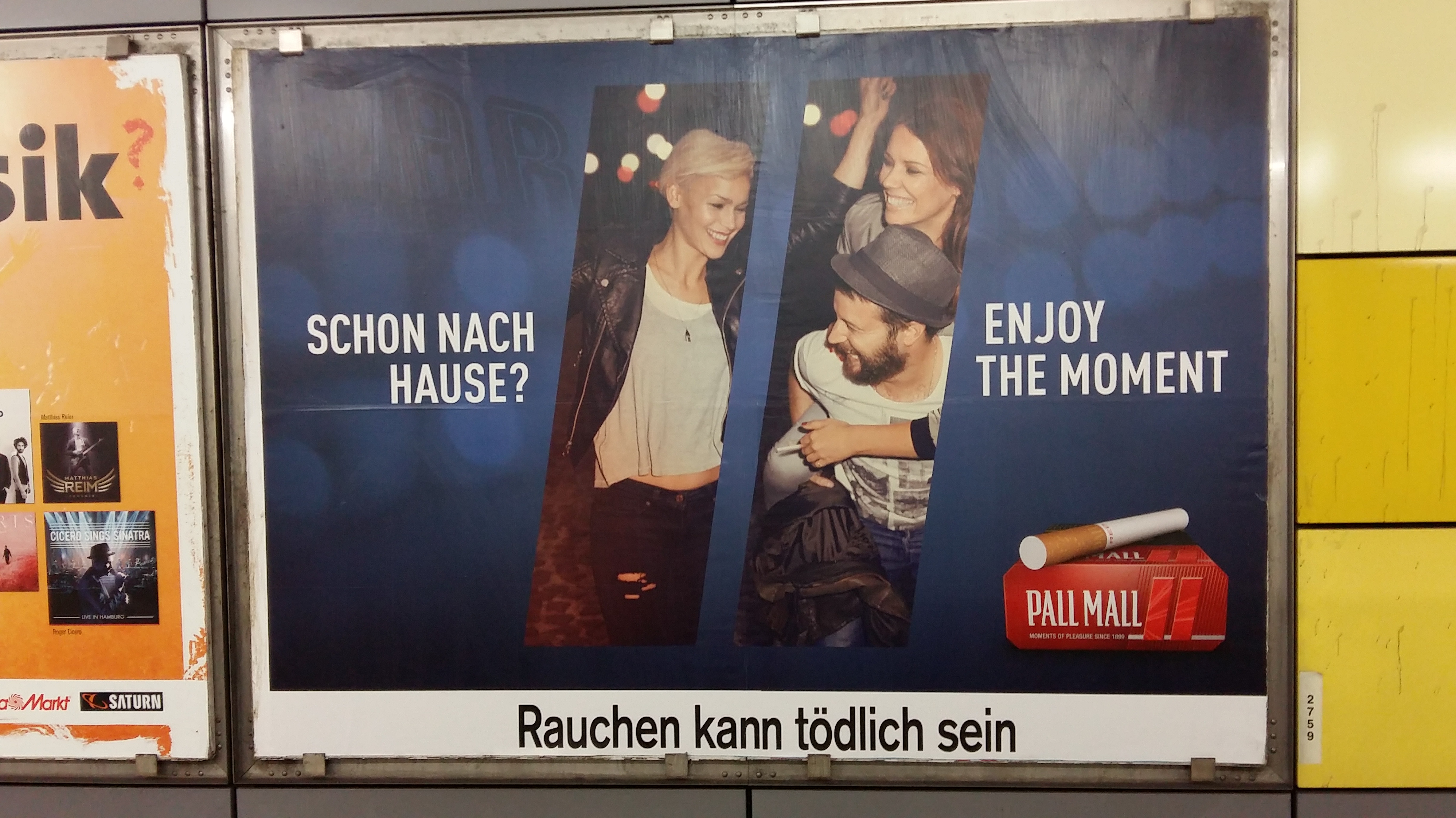 There has been a recent addition to the Pall Mall Enjoy the Moment campaign. Here we find two women, one with a cigarette, and a man giving the smoking woman a piggyback ride. The strapline “schon nach Hause” translates literally as “already at home”; naturally we enjoy the moment.
JPS’s men with spanners
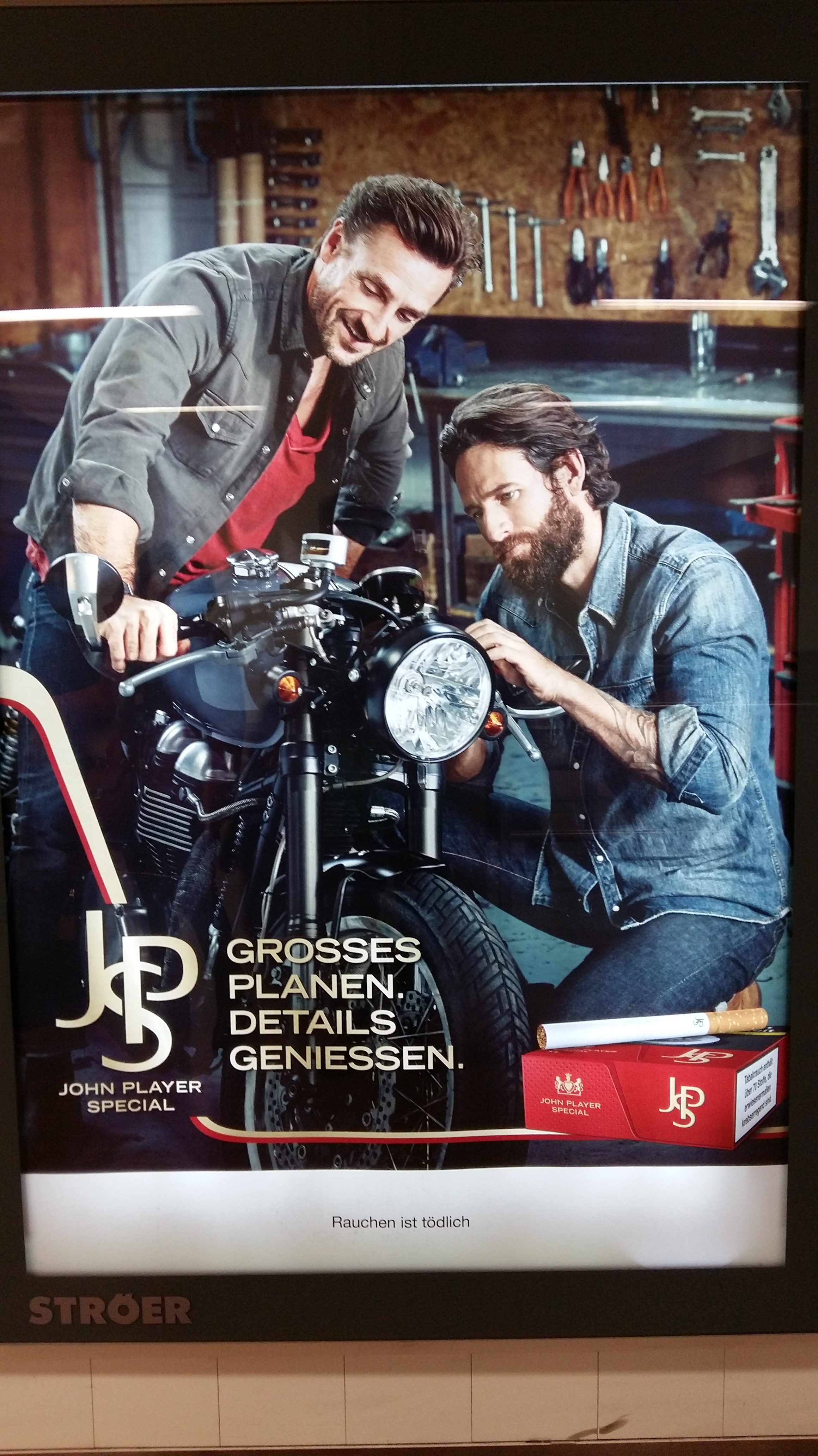 By goodness, the cigarette manufacturers do seem to like Hamburg as a city to market their lethal products. JPS (left), for example, occupies many of those smaller lit poster sites (bus shelters, etc.). What do we have here? Huge Plans. Enjoyable details. Presumably, let’s get that bolt sorted and we can go even faster on those infamous German autobahns. Better to die instantly now doing what we like rather than later with the inevitable chronic lung disease?
What insights can I add?
Filed under: International, Politics, Trump | Tags: Brexit, Donald Trump, Jon Snow, Theresa May
 Leave a comment
 I am observing, like most of us, events in the USA. This time last week, I shivered at that image of Theresa May, the UK Prime Minister, holding the hand of Donald Trump, President of the USA. OK, she held his hand to steady him as they walked down some stairs. He’s 70 after all.
I have struggled with Owen Smith, Labour’s leadership challenger and now rebel. But he has gone up in my estimation relating to the last week’s vote in the UK Parliament sanctioning the trigger for Article 50 – starting the process of exit.
Brexit in the context of Trump is a different proposition to the one at the time of the referendum in June 2016. Especially with UK International Trade Secretary, Liam Fox, being linked to Trump’s sinister corporate Dark Money (and notwithstanding Nigel Farage’s recent antics).
More significantly, however, is the realisation that we are all being hoodwinked by the Trump administration. Take, for example, Jon Snow’s tweet this morning where Trump has a go at his successor, Arnold Schwarzenegger, at the Apprentice reality TV show:
Now Jon Snow is a good journalist. Indeed, he will be running next week a series of programmes about fake news (maybe this is why he sent the above tweet). US journalists persist with the White House briefings and are lied to by Sean Spicer, Trump’s media spokesperson. But they persist. It really is the only world they know. But the issue is different: the protagonist has changed. There is plenty of fake news about, for sure. Blatant lies, yes. But these are distractions from what is really happening. The media is being distracted apart from Fox News, the source of news for most Trump’s supporters.
Time to wake up? It seems to me that the EU has woken up. Theresa May’s offer to act as a bridge between the EU and the USA was rejected. I’m undecided whether it was laughable that the British even offered to play this role in light of Brexit, or whether this is a maturing EU. An EU that realises that it will be the bulwark of democracy in the new world. The USA is going to be lost.
The concerted attempts to destroy the post-war consensus in the UK
The UK at the moment is in a mess.
Daily I am subject to the effects of ongoing industrial action by two transport unions – one for train drivers, one for (what we used to call) guards. It being a privatised and fragmented railway network, this is happening in a single region, and hence the effects are localised. The objective for the railway workers is to run the trains safely (drivers have recently been given total responsibility for safety on trains, over-and-above the driving, which they argue is not safe). The same unions are in dispute with Transport for London over safety and staffing on the London Underground.
Last week it was the turn of the National Health Service. People are dying waiting to get into a hospital. The Government is now blaming General Practitioners, the primary carers. Seemingly because they do not provide a 7-day service, too many people are going to the emergency departments in hospitals at weekends and evenings.
Then there is my own profession, university teaching. The Government’s priority is to push ahead with a bill that 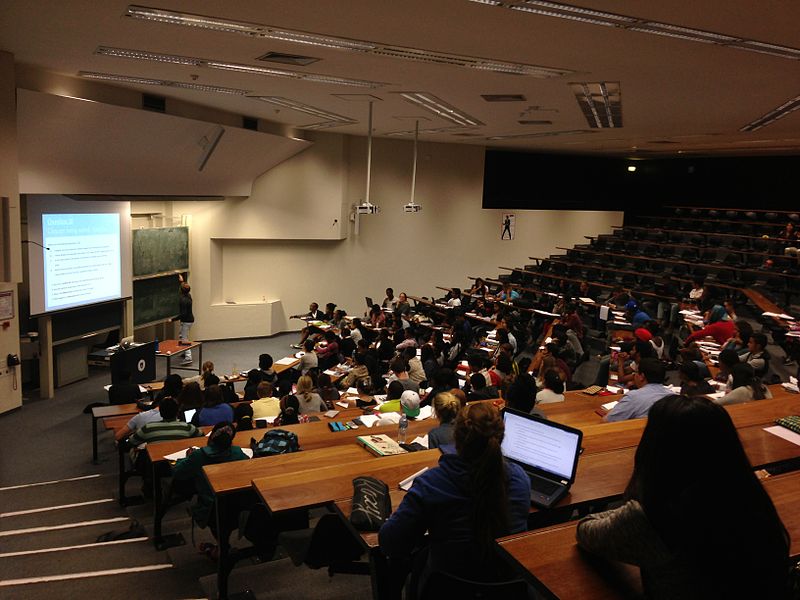 enables private companies to award degrees and add further metrics to the practice of teaching. This progressively turns teaching into a proscriptive exercise rather than a learning experience. The arrival of private companies, it is argued, will provide choice in the ‘education market’ (as if there are not enough universities to provide choice) and innovate.
My take is this. With respect to the railway disputes, this is a Government that wants to impose new working conditions on railway workers that have the potential to make travel less safe. We have seen this before at privatisation, It can be deadly.
With regard to universities, the advent of 9000 pound fees per year changed the relationship between teaching staff and students. The fees effectively commodified learning and universities have been complicit in this. Private companies such as the large publishing houses want to control content and merge their content production with delivery. This will squeeze out any critical thinking.
 As we have seen with Brexit, all is not what it seems. The Conservatives, with hindsight, were always Eurosceptic. They never embraced membership or tried to change it from within. The incoming Prime Minister, Theresa May, simply sees it as an opportunity. The opportunity to leave the jurisdiction of the European Court of Justice and to control border (something that she failed to achieve as home minister in the Cameron Government). The mandate from the referendum is there, even if the damage done to the economy is significant. This is not about the economy, it is about nationalism.
And not unrelated is the situation with the National Health Service. It is the ultimate outcome of a postwar rejection of conservatism. A majority Labour Government in 1948 enacted legislation to enable healthcare to be provided free at the point of use. The UK conservatives see now their opportunity to end this once and for all. They have pr ogressively been privatising it with many familiar private-sector firms cherry picking services (leaving the public sector with the difficult stuff like geriatric care and chronic illness). Now, the crisis that has erupted in recent weeks with Accident and Emergency services struggling, the blame has been put on General Practitioners who are opposing 7-day working. It is reported today that some are indicating their intention to leave the National Health Service. On the one hand, this looks like something that the Government cannot ignore. On the other hand, maybe it is just what they are looking for in order to introduce an insurance system?
Pictures: A lecture in progress in Leslie Soc-Sci building in theatre 2A.
Pall Mall first with 2017 billboards in Germany
I arrived in Munich last night to the delights of Pa ll Mall’s new campaign. The strap line is Enjoy the Moment. There are two posters doing the rounds – one of men (left) the other featuring a women and a man.
So, the scenario for the first one (left) is that the bloke on the left has lost a bet. The forfeit, however, is not what one might expect for a smoker, his life; rather the minor issue of his beard. I trust that his life ends in due course with ghastly lung 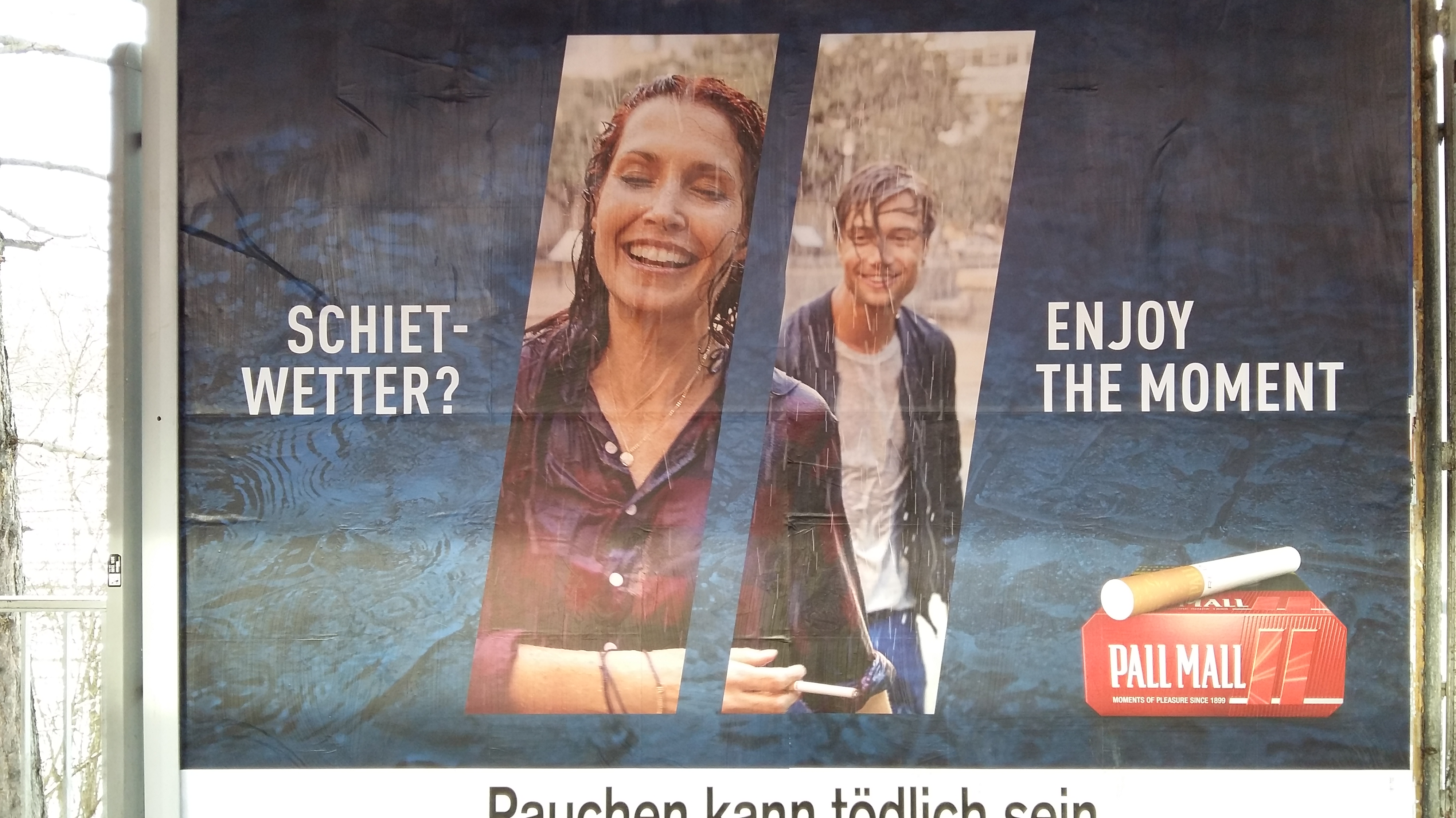 disease.
The second one sees a woman in the foreground and a man in the background enjoying the rain (Pall Mall has a thing about women getting wet while smoking). “Schiet Wetter” goes the strapline (I think we can all translate that). Enjoy the moment. Two things I enjoy not very much. Being wet and cigarette smoke, other people’s,naturally.
Researching Brexit and the effectiveness of dead cats
 It was in the UK General Election of 2015 that we seemingly encountered the concept of the dead cat. It was a campaign innovation by the Conservative Party’s campaign strategist, Linton Crosby (left). Essentially, throw the dead cat into the arena even if it is not a cat. Or dead. It does not matter. For most observers, it is a dead cat and it is the only thing that people can see. So, for example, linking Labour and the SNP – with Alec Salmond calling the shots. Never on, but enough to worry English voters (and possibly Scottish).
I mention this because this is the year that the implications of all of 2016’s successful dead cats – Brexit and Trump to name but two – will be realised. At least partially. Both fill me with foreboding – the former because of the apparent incompetence of the Government to manage the transition; the latter because…well, anxiety about a Trump presidency is natural, is it not? The bigger questions, however, are about how to counter the dead cat when it is thrown in to the arena and to understand the causes of the Brexit vote. I have short observations o n both of these.
Let me deal with Brexit vote first. Over the Christmas break I read a very interesting academic paper with some poignant empirical observations. The paper is called “The 2016 Referendum, Brexit and the Left Behind: An Aggregate-level Analysis of the Result”. The authors are Matthew J Goodwin and Oliver Heath and is published in the Political Quarterly (Vol 87(3), July September 2016). This is an early peer-reviewed analysis of available data that the authors have interrogated to ascertain who were the key voters. This is a summary of what they found:
- There is a statistically significant positive correlation between (high) levels of education and propensity to vote Remain (excluding London and Scotland).
- The over 65s – particularly in areas where UKIP polled well in the 2014 European Parliament elections – significantly voted Leave. So, 19 of the 20 “oldest” local authority areas voted Leave. By contrast, 16 of the 20 “youngest” local authority areas voted Remain (Oxford and Cambridge are the youngest of these). The exceptions again are London and Scotland.
- Areas with the fewest recent immigrants from the EU that were most likely to vote Leave (for example, South Staffordshire and the West Midlands). Of the 20 local authority areas with the most EU migrants, 18 voted Remain.
- Those local authority areas that have experienced a sudden increase in the number of EU migrants over the last 10 years tended to me more pro-Leave.
What conclusions can be drawn from this analysis? The authors conclude that the Brexit vote was determined by a high turnout by older voters, those with lower educational qualifications and in lower-skilled jobs. Essentially, those “left behind” in terms of economic transformation and whose values are at odds with those of a “liberal elite”. I conclude that these are all political factors that successive UK governments have ignored.
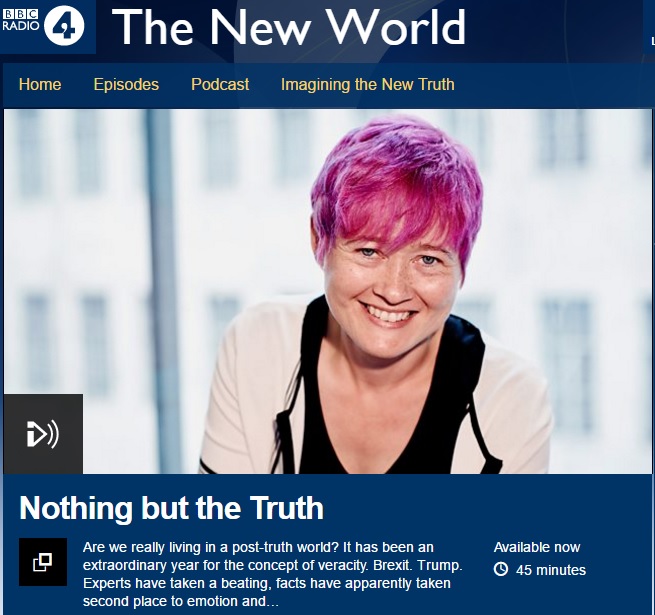 So, what do I have to say about dead cats? I was listening to an excellent suite of programmes on BBC Radio 4 this week under the umbrella title of The New World. In the the first of these, Jo Fidgen examined the concept of post truth. In this programme, there were a few uncomfortable findings. It seems that we are all as likely as each other to disregard the truth particularly if we disagree (with it) and live with others who disagree. Most disturbing is the dead cat syndrome. Fidgen uses the example of a murder inquiry to make the point. An aristocrat has her jewelry stolen. The media report that the gardener had been arrested on suspicion of the theft. However, the gardener was released with no charge; but in a controlled experiment, on his release, a sample of people still believed that he was guilty, despite the no charge report. It was not until the media reported that the butler had then been arrested and charged that the people in the sample were prepared to believe that the dead cat gardener was in fact innocent. Truth is perhaps beyond political.
Gauloises does carefree dancing in the street
Filed under: Cigarette advertising | Tags: Gauloises, Lucky Strike
Comments (2) So, Gauloises is rehashing some of  the imagery of its Vive le Moment advertising campaign. New taglines. I have seen a newer version of the women with moustaches on railway stations without having the option of taking a photo. But the young couple dancing in the street is completely new to me. What is going on here? Tagline is “Old Love, rejoined, new fire”. Erm….ok. So, young couple break up and get back together again with new energy, hence the dancing in the street. Enjoy the moment, for sure.
What I am confused about here is the law on advertising in Germany. In my previous post on the subject, it was clear that negative images of the effects of smoking were explicit with the foetus in the ashtray. But here, with the exception of the small black writing at the bottom “smoking is deadly” (upgraded from “smoking can be deadly”), all is idyllic.
It’s racism, not the economy
A couple of days ago, I wrote a post flagging up the considered view of Professor John Gray on the potential motivation of voters in the USA and the election of Donald Trump. The underlying point of his “letter” is that economic factors rather than social factors account for the result.
This opinion is not shared by all, and for good reason. The ever-vigilent Mehdi Hasan – has looked at the available data on the demographic that voted for Trump. It may not be as clear cut as we had thought. In actual fact, he argues, those who have been left behind economically – despite the logic – were not those who voted Trump. Rather it was those who have done better than average under neo-liberalism who put him in the White House. And the disturbing conclusion is not that the election was decided on economic issues. It was pure racism.
Luckies hoping we do not notice?
Filed under: Cigarette advertising | Tags: Camel, Gauloises, Luckies, marlboro
Comments (1)  I suppose that when the UK leaves the EU and Nigel Farage becomes PM at the behest of the US President, then cigarette advertising will be back on the streets of the UK as they are in Germany. The run up to Christmas is not the best time to see this particular species of advertising, but the Lucky Strike – Luckies – brand is loitering in U-Bahn Stations in Munich (left).
What is interesting about this one, notwithstanding its lack of imagination – good deal and thick, if my translation is up to it – is that it is forced to show something nasty on the front. Inside the black band on the packet is an ashtray with the ash forming the shape of a foetus. This is the first time that I have seen this on street posters. It raises the question as to whether the advertisers could have avoided this by not showing the packet? If they are able to do so, then this is an even more stupid billboard than I had first thought. If they cannot, how is the negative image going to be represeted on more alluring advertising such as that practised by Marlboro, Camel and Gauloises? I trust the answer will come like the answer to plenty of other potentially lethal questions (Trump, le Pen, Wilders) in the much-anticipated 2017!
 Be informed
