B&H marketers seem to go to the wrong gigs
Filed under: Cigarette advertising | Tags: B&H, Benson and Hedges
 Leave a Comment
  It seems to me that only at truly awful gigs is it better to stand outside with a bunch of nicotine addicts rather than enjoy to music of a live band. And even then I am not sure. Seemingly not in B&H world (left). The caption reads “Inside plays the band. Outside the music”. Essentially, spending time with/being ignored by (as the woman seems to be) two unshaven men is better than watching Richard Hawley, for example. I think not.
Richard Hawley, Brighton Dome, 25 October 2015
 Richard Hawley (left), denizen of Sheffield and purveyor of guitar baritone romance and melancholy is difficult to match. We were quite late to the party and had to wait even longer to get to see him. His first words when he came on stage were “we’re back!” For some, maybe.
He played for getting on 95 minutes with his band Shez Sheridan (best mate and guitar), Dean Beresford (Drums), Colin Elliot (bass) and Jon Trier (keyboards and known to Hawley as the Librarian). Good value, if nothing else. With a new album to plug, one might have expected a full track listing. But this is a rather humble and knowing Richard Hawley. We were treated to the full range across the repertoire and the six-and-a-half albums of which I have four, including his latest, Hollow Meadows.
He dedicated to his audience a track from Hollow Meadows, Heart of Oak, as a metaphor for his loyal followers. That was nice. We were treated to the romantic hits, Open up your Door (from Truelove’s Gutter), The Ocean (from Coles Corner) and Tonight the Streets are Ours (from Lady’s Bridge). For those in the audience wanting louder – and the audience was a shade vocal, almost hecklers at one point – got a good chunk of his very loud album, Standing at the Sky’s Edge including the title track, She Brings the Sunlight and the quieter Don’t Stare at the Sun. This is an album, so loud is it, that one needs a lyric sheet. If you want loud, this is the section of the gig for you.
So, the music was great and sustained. The banter good natured. But the care with which the set was played 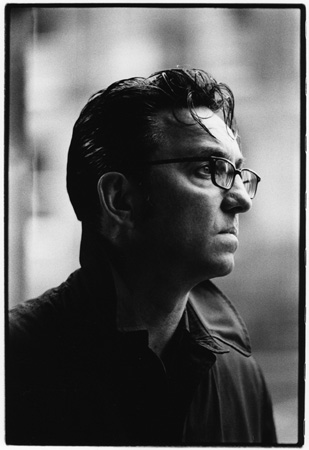 impressed me no end. Hawley has a guitar dresser or caddy (as golfers have). The said character was a wisp-like man in jeans and a tee-shirt armed with a duster and a keen ear for tuning. Each of Hawley’s guitars (at least eight) got his tender loving care. Tuned to perfection and the dusted so that they sparkled in the lights. Hawley’s attire is equally choreographed. It might only be a pair of jeans and denim jacket. But it is an ironed pair of jeans and denim jacket.
Here is the Independent’s review of the same gig: http://tinyurl.com/p68dmhe
Pic (right): http://www.richardhawley.co.uk/photos/promo/
At the time of writing the remaining gigs are the following:
Wed October 28 2015 – SCARBOROUGH Spa
Fri October 30 2015 – DUBLIN Vicar Street
Sun November 01 2015 – LEEDS O2 Academy Leeds
Mon November 02 2015 – MANCHESTER Albert Hall
Tue November 03 2015 – GATESHEAD Sage Gateshead
Thu November 05 2015 – GLASGOW Barrowland
Fri November 06 2015 – SHEFFIELD Sheffield Arena
Sun November 08 2015 – LONDON Roundhouse
Mon November 09 2015 – BRISTOL Colston Hall
Tue November 10 2015 – SOUTHAMPTON O2 Guildhall Southampton
Sat February 20 2016 – SOUTHAMPTON O2 Guildhall Southampton
Sun February 21 2016 – NORWICH The Nick Rayns LCR
Tue February 23 2016 – LONDON Eventim Apollo
Wed February 24 2016 – MANCHESTER O2 Apollo
Sun February 28 2016 – CARDIFF Cardiff University
New death delivery method
Filed under: Cigarette advertising | Tags: Lucky Strike, marlboro
Comments (1)  I wish I was as advanced as the product developers at Marlboro (bottom rigtht) and Lucky Strike (left). Is this the innovation equivalent of vinyl to cassette in the music industry (i.e. not really)? So, there are new filters on the market delivering “a cleaner taste” (Marlboro does not even bother to accommodate the language of the smoker, in this case German) and mildness through a “new flow filter” (Lucky Strike).
It does seem that the designers of the Marlboro poster did not trial it properly. On this example, if the poster is not perfectly pasted on the billboard, it does not matter how advanced the filter, the cigarette itself seems a shade, what can I say, bent. Never mind, advanced cigarettes are just as effective at delivering death as their predecessors.
Increasingly undemocratic
 Some regular readers of this blog have expressed a disappointment over the lack of political content in recent months. To paraphrase, “I do not care about your tandem tour or cigarette advertising, but I do like to read what you think about…Jeremy Corbyn (left) or whoever/whatever”. Like a few of my peers, since the UK General Election in May, it has been quite difficult to muster much in the way of enthusiasm for writing about politics in the knowledge that a significant minority of the population voted for a bunch of lying, thieving and privileged men (largely) to run (down) the country, destroy the trade unions and the Labour Party and oppress working people.
What Cameron said about Jeremy Corbyn at the Tory Party conference earlier this month was outrageous slander. It is true that Corbyn was elected the leader of the Labour Party against all of the odds and in spite of the best efforts of the Tory-lite brigade within the party and their media friends. It is refreshing to hear a leading politician publicly renounce the use of nuclear weapons, expose the lie of the deficit, decline to sing the national anthem and bow before the queen.
Let’s just deal with the national anthem and patriotism. I regard myself as being fiercely patriotic without being nationalistic. I do not sing the national anthem, even at the Proms of which I am passionate. However, as a republican atheist, it is quite difficult to retain authenticity if one starts singing “God Save the Queen”. Surely? Corbyn was respectful at the Battle of Britain memorial service. He just did not sing the words. Moreover, if one listens to national anthems the world over, mostly they say something about the country, its people, the landscape, etc. The British National Anthem says nothing about these things. It is unsingable for any rational patriot.
Another thing that defines Corbyn is his commitment to democracy. OK, sometimes leadership is necessary, and merely listening might not be enough. The Conservative Government realise that their programme cannot be taken through the UK parliament and be ratified. There is simply not enough support for the programme in both houses. So what does the Government do? Find a way of not taking policy through normal channels, that’s what. For example, there is a law against new selective grammar schools in the UK. They are regressive and favour the already privileged children of middle- and upper-class parents. So instead of trying to get the legislation through parliament – which the Government knows is impossible – it sanctions the establishment of a new school as an annex of an existing school some 20km away, claiming that it is not a new school.
Then there is the issue about sale of social housing units – housing association properties to you and me. Notwithstanding the fact that attempts to sell off social housing stock at a discount is a bad idea as it transfers much needed affordable housing into the private sector funded by us, the taxpayer, to benefit private landlord (this is what happened with the sale of council houses in the 1980s). Additionally, Housing Associations are separate entities from the state and government. The houses are not the Government’s to sell. Yet. Again, knowing that it cannot get this measure through the Parliament, what has the Government done? Well, it has negotiated with the National Housing Federation an extra-parliamentary deal. According to the Guardian newspaper “Housing association leaders believe a voluntary deal will guarantee their independence as charities and private housing providers, and head off a full-scale battle with government, which has been critical in recent weeks of association performance and efficiency.” In other words, taking on the Government would undermine charitable status, a central plank of their identity and constitution. Essentially, they would then just become private companies, like any other. Or more likely public assets and available for sale. Fortunately, some Associations are resisting this bullying. Overwhelmingly.
Picture: Jeremy Corbyn by JMiall, Wikipedia
Never smart, always square
Filed under: Cigarette advertising | Tags: John Player Special
Leave a Comment  Talking of John Player, here’s the latest offering from the JPS brand’s autumn campaign. As if smoking is not enough of a death wish, this bloke (wearing his suit and satchel) is smoking whilst on a skateboard on a busy road probably following lots of VW diesel cars just to show how cool he is. To make matters even worse for the brand, its own strapline is “Born that way…” Indeed!
Time to argue
 I remember many years ago when I first went to Northern College in Barnsley in the early 1980s, many of the students smoked in class. This was allowed, at least for the first year of my studies. Bizarre to think about it now. One of the favourite brands at that time was John Player Superkings. Super meant, very large. As a consequence, they took longer for the smoker to finish. This enabled us passive smokers, more free pleasure.
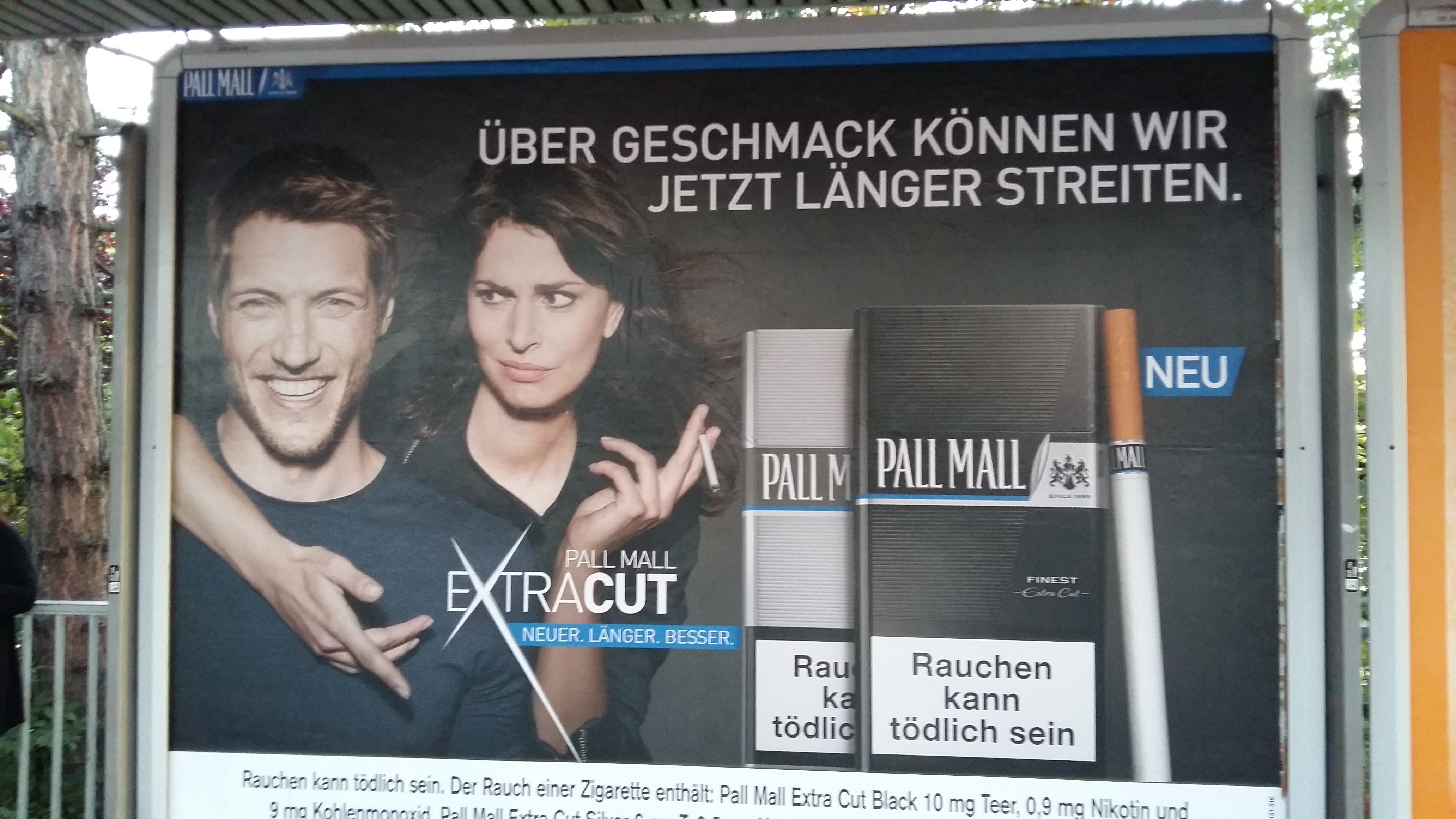
Pall Mall seems to be visiting the past with a series of advertisement posters in Germany for their equivalent brand, Extra Cut (above left). The strapline translates, I think, as “about the taste, we can argue for longer”. Though the extremely intelligent and witty people at the ad agency don’t really think that the couple in the picture are arguing about the taste. One can tell by the expressions on their faces, I think. He’s just being a cad. She’s having a fag because he’s a cad. Never mind, there is always death to look forward to. That will give them something to argue about. Not much pleasure there.
Tandem Tour 2015: Kitzingen to Bamberg via Sand am Main

The main route heading north and east is a delight.

It is still significant enough to experiece ferries and sizeable bridges, some of which riders are required to use. We travelled in a northerly direction towards Dettelbach. This is very much wine country and Dettelbach (below right) is twee and offers a considerable – and probably necessary – marketing opportunity for growers. They have hostelries on the road side with opportunities to sample the local wine and  then buy a crate. We acquired a taste for Domina (a fruity red) and Spätburgunder (another word for Pinot Noir). Suffice to say, we did not carry a crate on the tandem.
We actually stopped at Volkach for lunch where, clearly, we should have stopped at the St. Maria im Weingarten church, the home of another Riemenschneider carving. But we hadn’t done our homework. However, by way of compensation, and as is so often the case, one 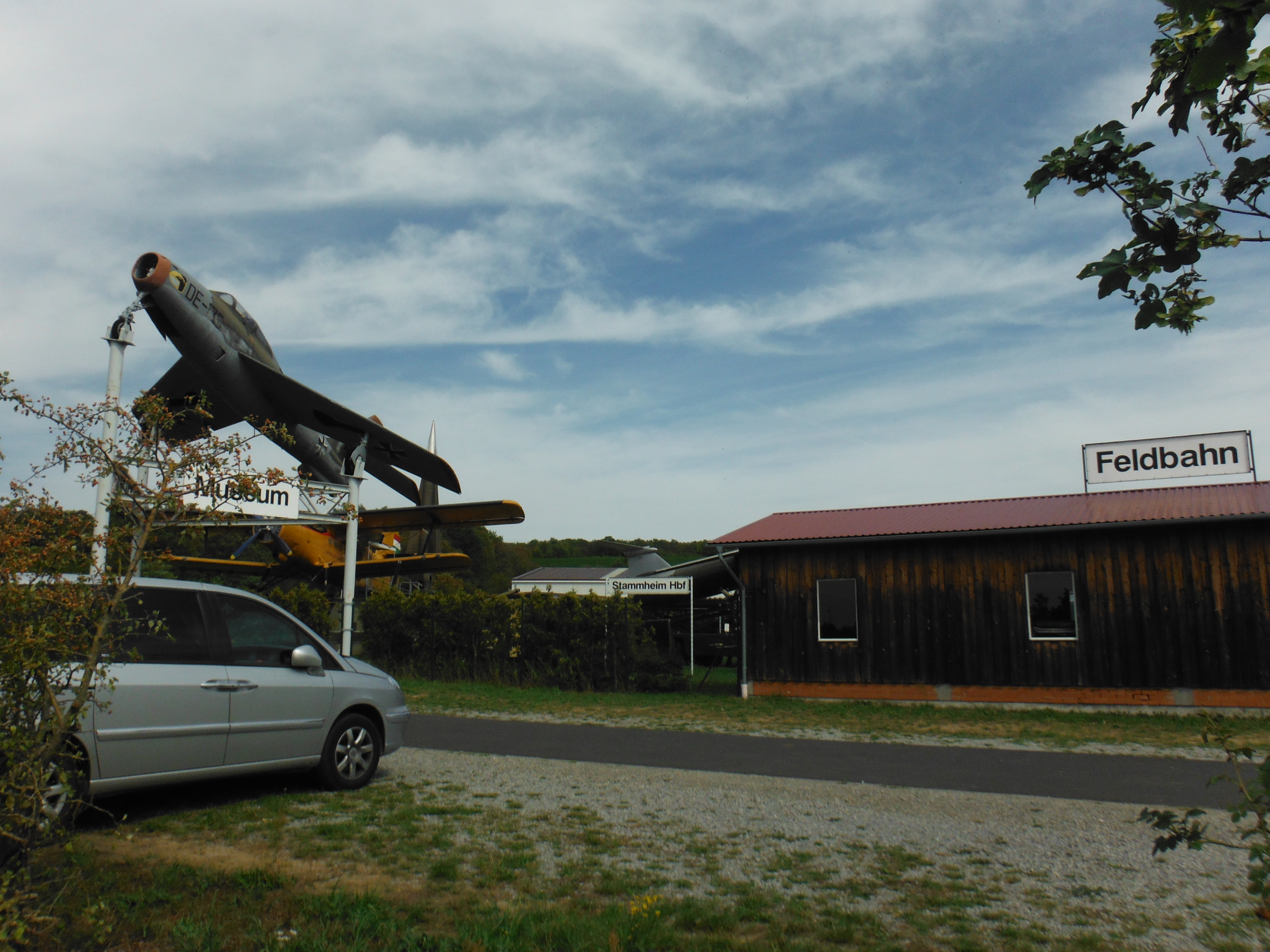 stumbles upon strange – sometimes inexplicable – attractions. So at Stammheim, one encounters an air museum (left). And a ferry. I love ferry rides across rivers (below right).
Onward towards Schweinfurt which is a not insignificant industrial town. It produced most of the Nazi war machine’s ball bearings. For that reason it was a target of allied forces in 1945. It retains significant metal industry facilities. But if one follows the track, the city is largely bypassed.
Next up is Haßfurt, again somewhat bypassed. We were keen to get to our preferred campsite at Sand am Main. We took a little detour adjacent to an airfield, surprisingly busy with small and micro aircraft. Sand am Main proved not as easy to get to as we might have thought. There is a lot of water which requires one to ride over the correct bridge just to the east of Knetzgau. The campsite is actually on the banks of Sanderbaggersee and is, consequently, relatively easy to find once in Sand.
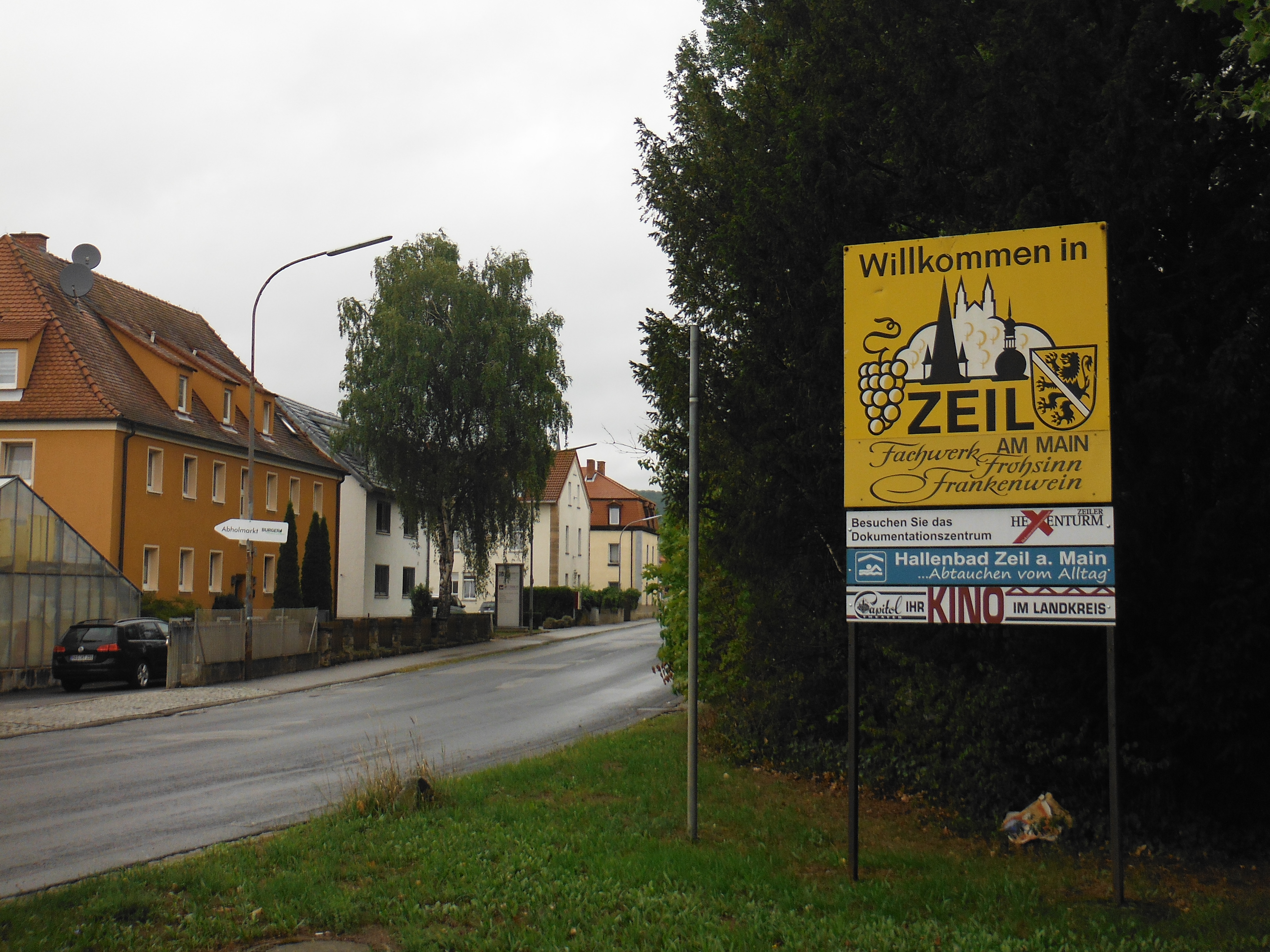 Time for a day off from the tandem. The next day we walked into the nearby Zeil am Main (left), a centre for furniture manufacture, and caught the train into Bamberg. Bamberg – or at least its centre – is a UNESCO World Heritage Site. And it is extraordinary. It has a thousand years of history, much of it religious. It lost its status as a city state in 1803 becoming part of the Bavarian kingdom.
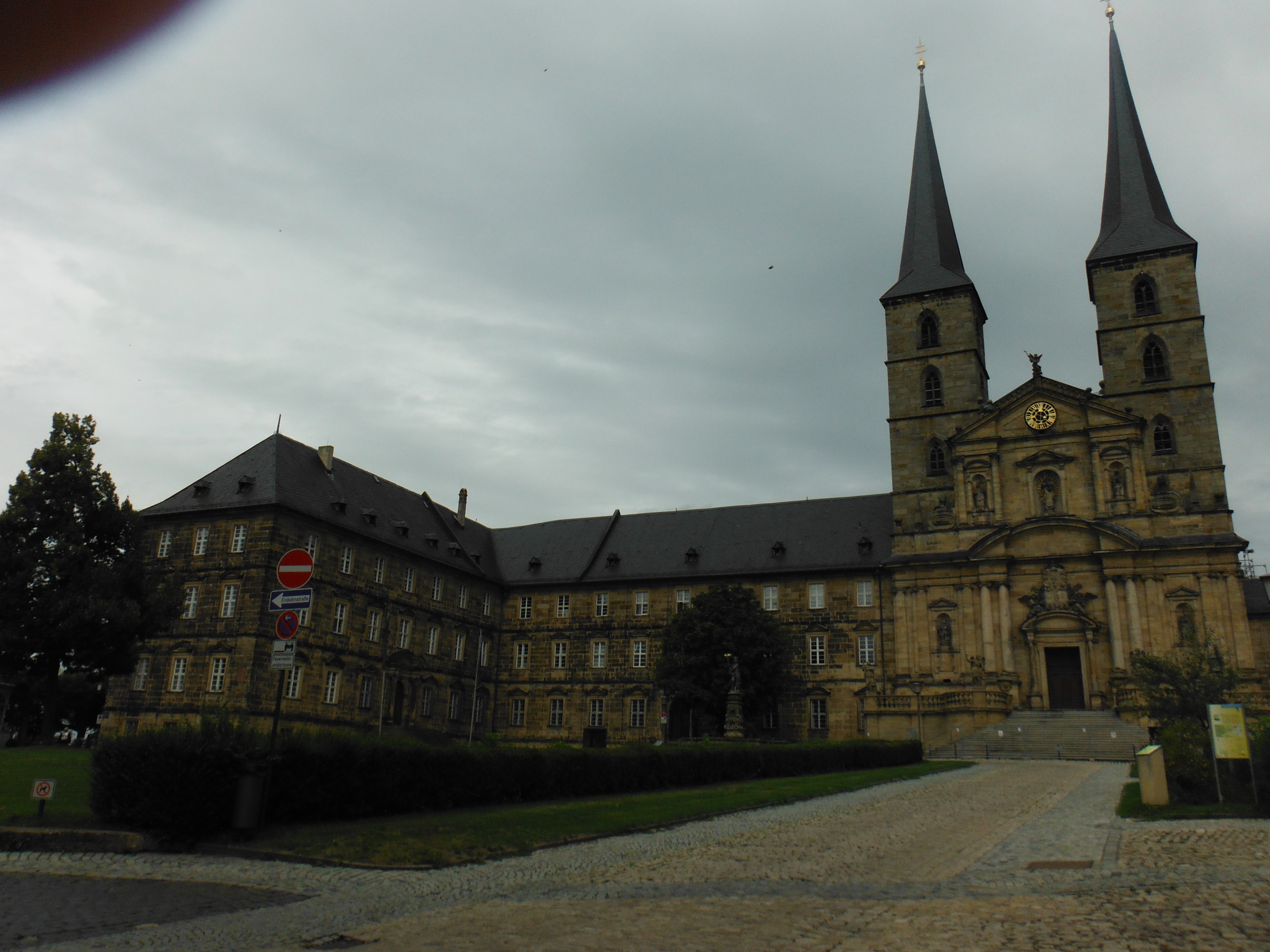
It is certainly a hilly place (there are 7 hills, die Hügel), thus enjoying the architecture requires some strenuous walking. The stone used for the buildings gives it an unwarranted industrial feel. The Cathedral (right) is, for example, built from a sandy-coloured stone, as is the nearby Michaelsberg Abbey (below right). The cathedral dates from the 13th Century and is described as romanesque (Bamberg is often described, inappropriately, as Bavaria’s Rome). As for the  interior, one can find an ornate Riemenschneider tomb sculpted from marble (left). It was sculpted for Heinrich II and his wife (Kunigunde), and dates from the early 16th Century. It is adorned with carvings capturing a series of complex stories. For example, Kunigunde was challenged on her faithfulness to the King
 (left). She was essentially cleared after proving her faithfulness by runing over some hot sharp metal without injury!
Bamberg also has a history steeped in beer, not unlike most Bavarian towns, it has to be said. There is one very special beer, however, that had to be tried. That beer was Aecht Schlenkerla Rauchbier (essentially, dark smoked bier). The beer is smoked arising out of an 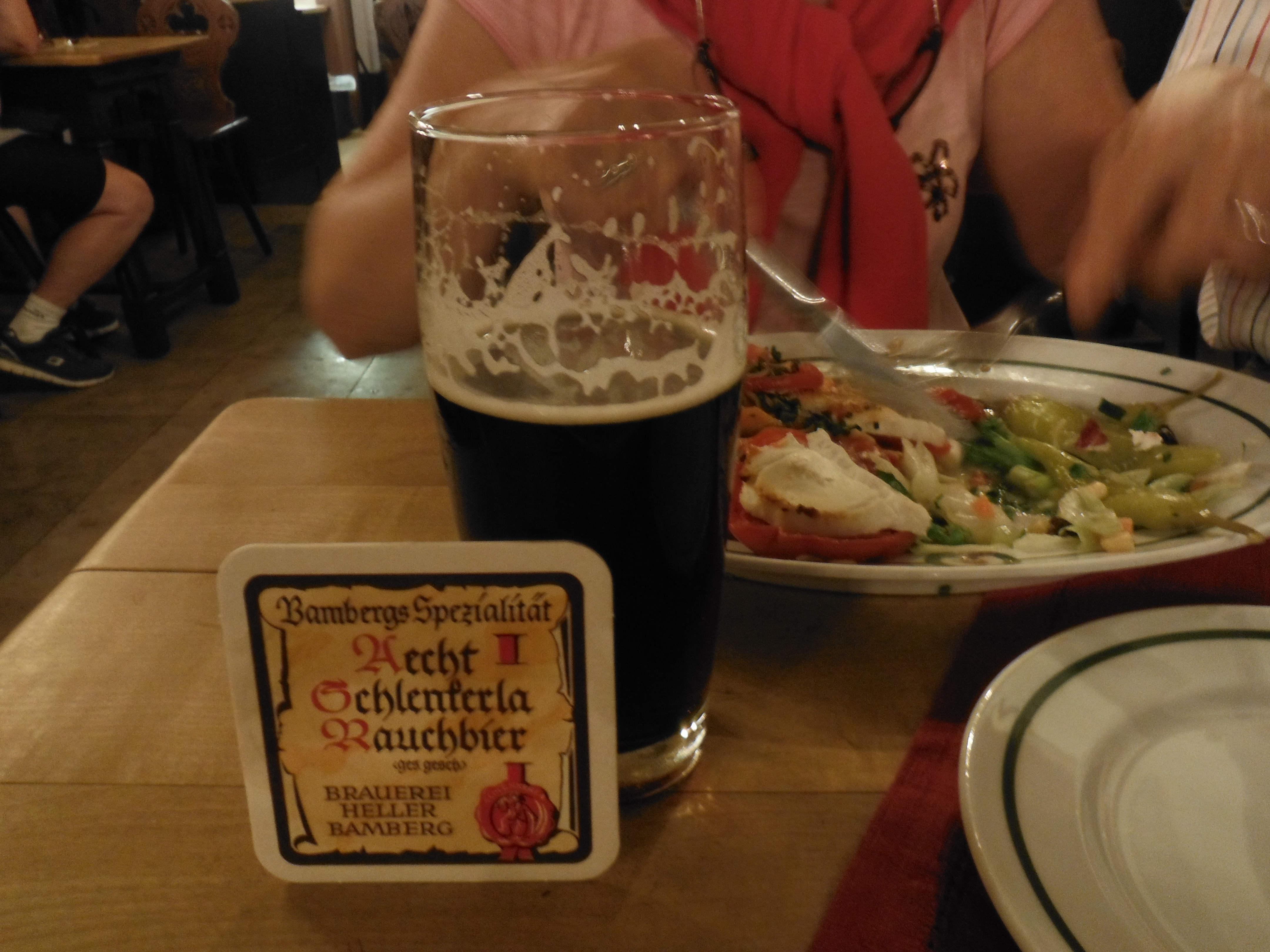 accident. Fire damaged the brewery and soiled the ingredients including the hops. However, waste not want not, as-it-were. The next batch of beer had, not surprisingly, a smoked flavour. I have to say, one glass was enough. The hostelry itself offers traditional complementary food which is quick (the turnover inside is rapid) and surprisingly good, even for a vegetarian.
Tandem Tour 2015: Tauberbishofsheim to Kitzingen via Würzburg
 Rather than go all the way along the Tauber to Wertheim to join the Main, we decided to go direct and take what is known as the Romantic Route linking Werbach
 just north of Tauberbishofsheim and Würzburg via Alterheim. The route is well signposted (right) but, as a route it is not as well developed as the river routes. Essentially, treat it like a motorway with no services on it. Take food and water because this is not an easy 30km or so. That said, Werbach to Würzburg is easier than the other way around. The gradients are kinder. Not surprisingly, it is also much quieter.
When Würzburg arrives, it is fantastic.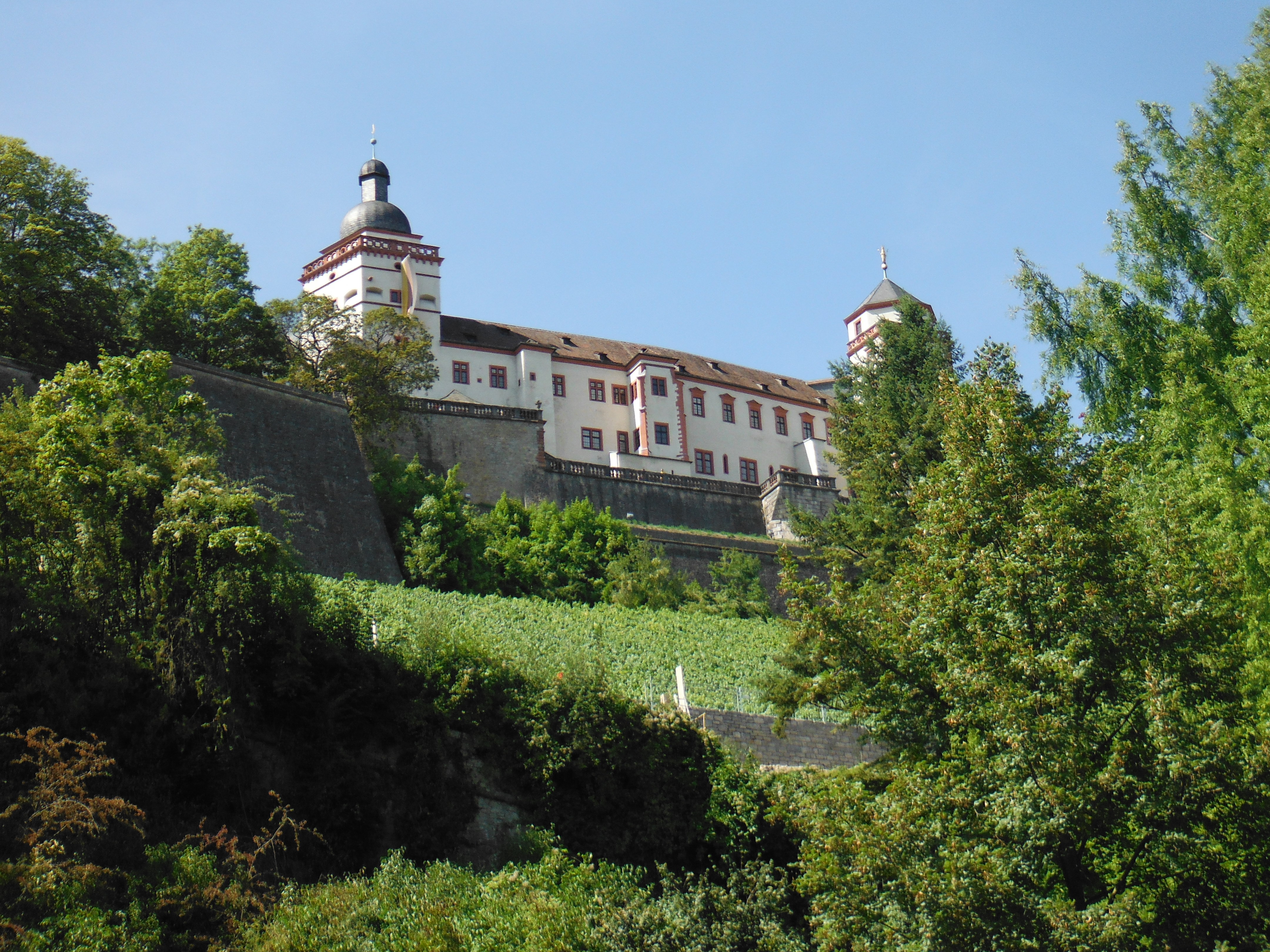 The Fortress Marienburg (left) dominates the skyline and the city centre is as architcturally rich as any in the region. Though it is also a working city where the tourists are contained.
The Würzburger Residenz is a UNESCO World Heritage Site originally built between 1720 and 1744. The Rathaus (right) is a 14th Century building, but like the historic centres of many German cities it was severely damaged by allied bombs in 1945 (a firestorm on 16 March 1945 killed 5000 civilians). Fittingly, much of the historic centre was rebuilt. The Cathedral, moreover, has two examples of 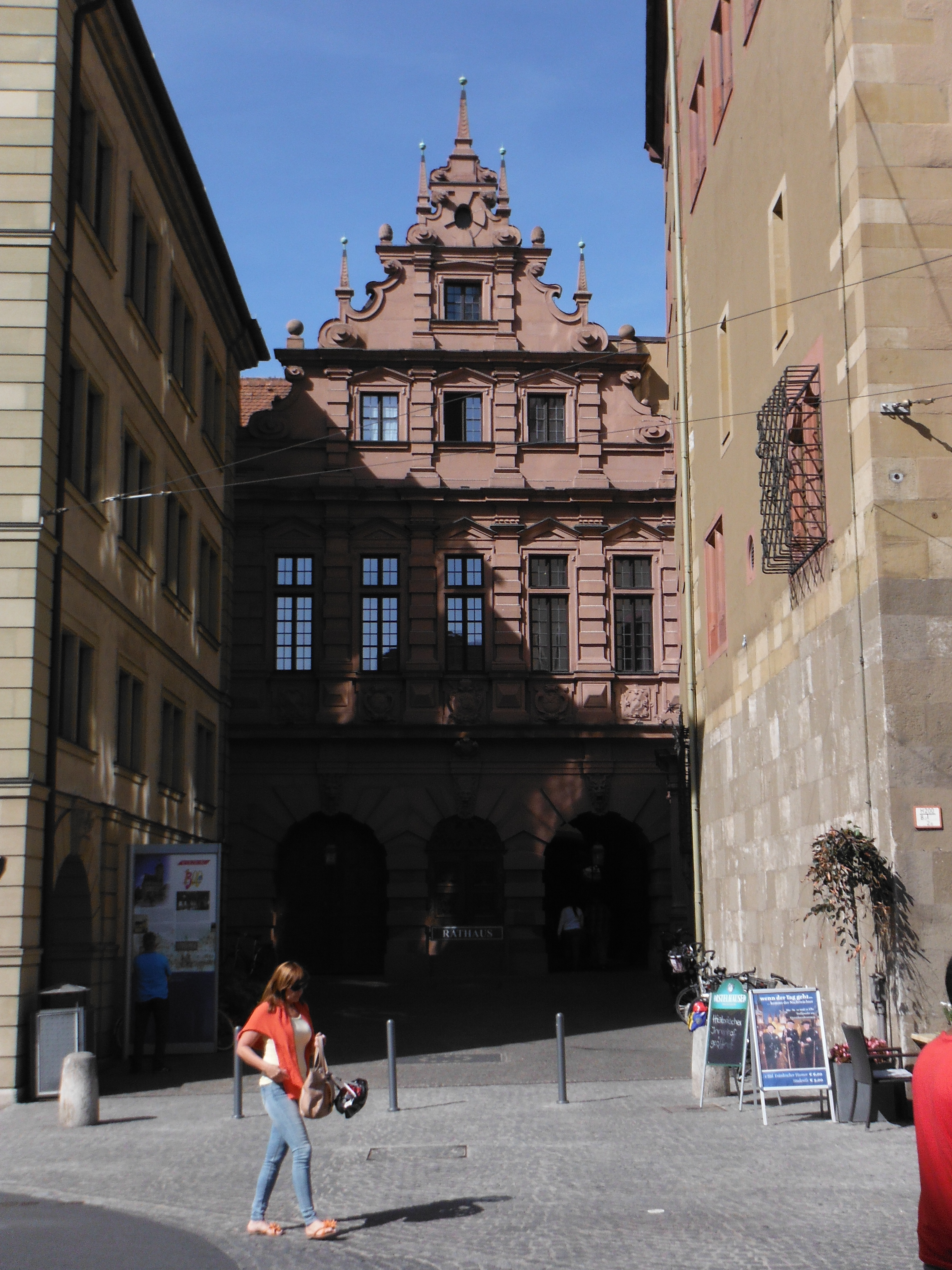 Riemenschneider’s extraordinary carvings.
We ate well at the Ratskeller before heading to the river and following the Main Radweg to Kitzingen. This takes riders principally through the historic town of Ochsenfurt. Just short of Kinzingen is the excellent riverside campsite. Kinzingen is another picture postcard town, the history of which is closely related to the Church, Würzburg and Napoleon.
 Breakfast opportunities are considerable. It is also very cylcle friendly. First of all, if one has an e-bike – of which there are many to be seen on these cycle routes – there is a charging station. But more interestingly, there are secure luggage lockers (left) for cyclists!
Tandem Tour 2015: Eichstätt to Tauberbishofsheim
 Breakfast is usually in some Konditorei in one of the many towns. Coffee and freshly made bread with jam and cheese fits the bill nicely. In Eichstätt we found one on the cycle route out of the town.
The next section is has a lot to recommend it. The cycle route shares a railway line in the valley as it passess through Dollnstein and Solnhofen (a major part of the local economy is stone – stein – this influences many of the place names). Further on is Treuchtlingen. In the Kurpark, one finds the seemingly incongruously located steam locomotive rather forlornly dumped (right). The town itself was having a siesta when we passed through it (to be fair, it was very hot). But ultimately it is an old market town famous for handcrafts and silk. The aforementioned railway link to Ingolstadt and Munich, built in 1869, was key to the town’s industrial development. But there is a further significance, the railway station was bombed on 23 February 1945 by the allies. 300 people died on one train in the station. Maybe the forlorn locomotive fittingly commemorates that terrible event?
 A little further along the river is Gunzenhausen, a resort on the Altmühlsee, a large inland lake (left). We camped there, breakfasting at a cafe on the shoreline. We then continued our tour north west towards Rothenburg ob der Tauber through Leutershausen and Colmburg. There is a bit of cross country to be done here and if you suitably miss the path,
 as we did, you can be diverted into villages that show some of the eccentricities of the Bavarians relating to their gardens (right). I cannot quite remember in which village this scene of life and fantasy was discovered. But it made the detour worthwhile.
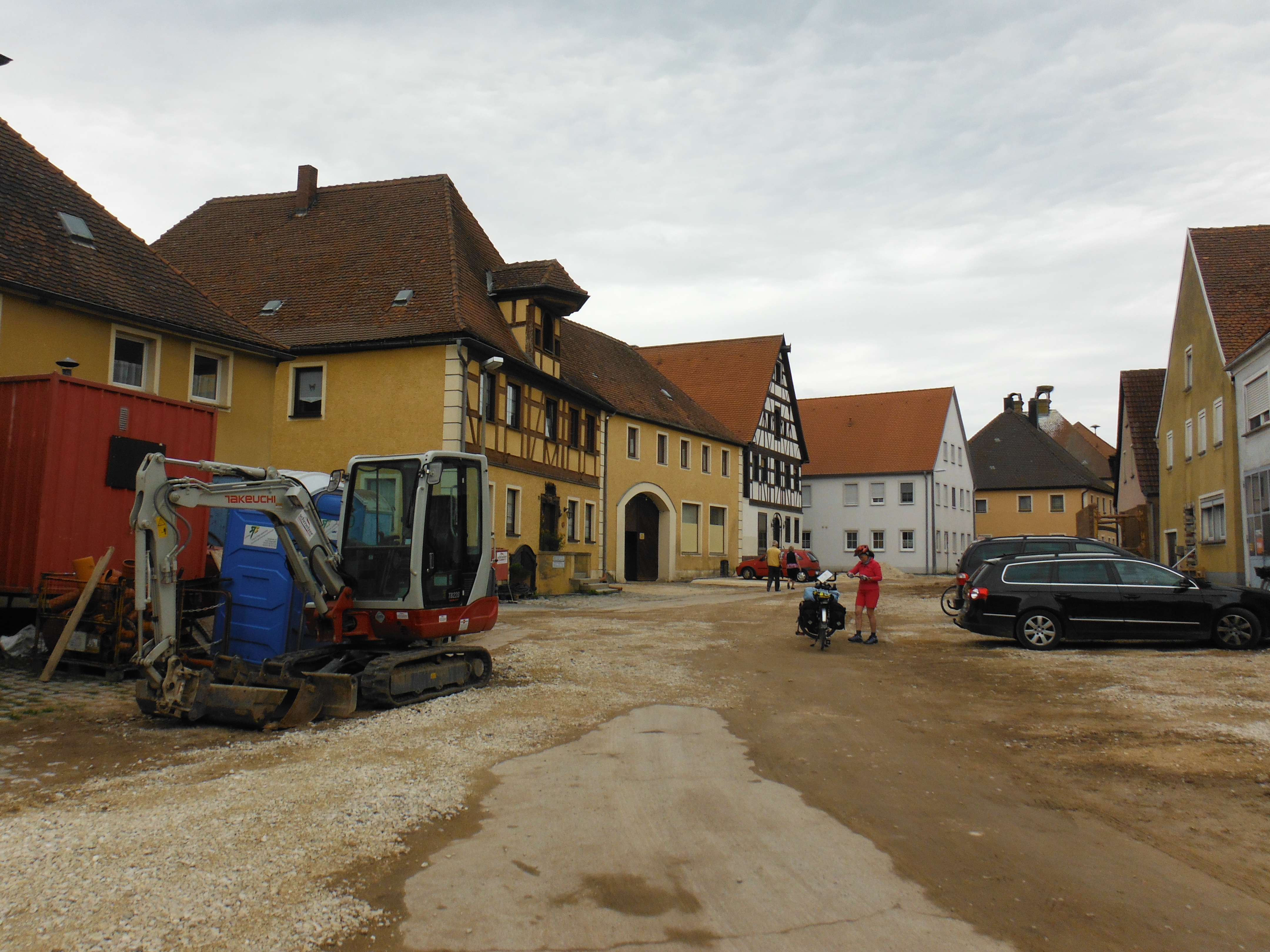 A little further on, we found another village (left) that was not quite looking its best. I was expecting a sign saying something like “sorry we are not looking our best, come back in 6 months…please”.
We found ourselves in Gasthof zur Krone having coffee and Apfel Strudel in Leutershausen (the Gasthof kitchens in Bavaria are mostly closed between 1500 and 1800, there is little hot food to get). The landlord told us that rain was forecast for around 6pm and if we wanted to make it to Rothenburg before it came (we were keen to get the tent up before it set in) then we should take a short cut. The road that was recommended seemed rather substantial (st2249). But in the event, largely unused. A recommended detour. A bit more hilly, though.
And then Rothenburg itself. First we would say, if you want to visit the town, go direct. Do not follow the cycle track as it steeply descends into the valley and the way back up is tortuous. The town is significant in its history and is home to an amazing Tilman Riemenscheider alterpiece carving – something we discovered only on getting back and watching again Andrew Graham Dixon’s BBC documentary, The Art of Germany (though if we had read our guide close enough, we would also have known). Indeed there are many Riemenschneider carvings in Bavaria. We stopped off at two further churches containing examples of his work at Detwang (where we camped and pictured, above right) and a shade futher on the Herrgottskirche to the south of Credlingen on the L1005 (and don’t forget the Thimble Museum, below left).
The campsite at Det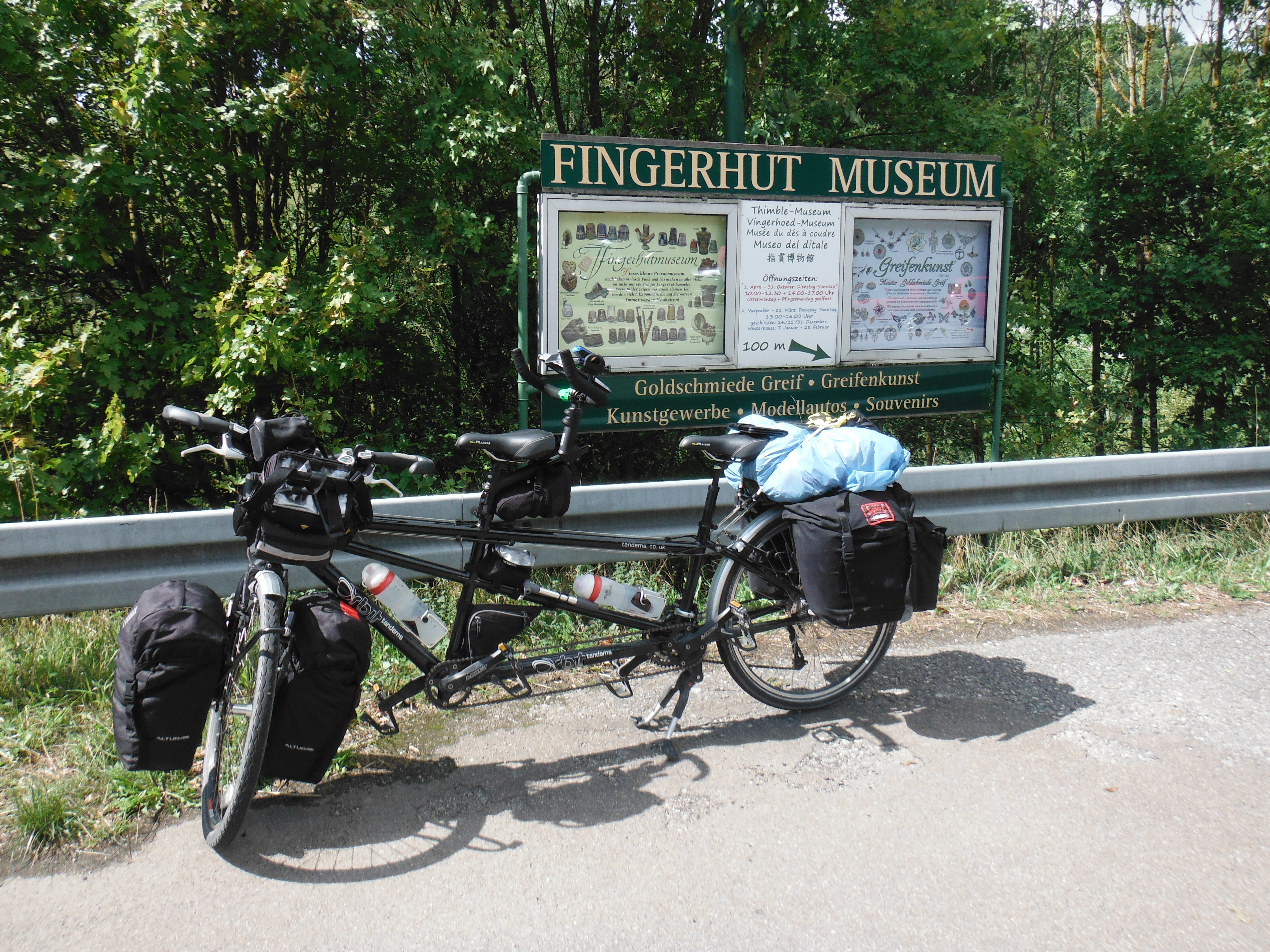 wang is described elsewhere. With heavy rain we abandoned any idea of getting into Rothenburg and elected to eat in one of the Gastätte in the village. Monday and Tuesday are closing days for one of the restaurants. We had, therefore, no choice but to go to the Gasthaus Tauberstube (http://tinyurl.com/o2yhwsy) despite a note on the door saying reservations only for the evening. It was great, though traditional food. They were well prepared to offer us something vegetarian. And we drank some local wine. The next day we met the landlord in another cafe in Credlingen – he was clearly checking up on the local competition! He recognised us even though we were on a tandem and wearing our gear. We have to revisit Rothenburg. I think we now know where to stay.
Onward towards our next stop, Tauberbishofsheim through the attractive towns of Röttingen, Weikersheim (right) and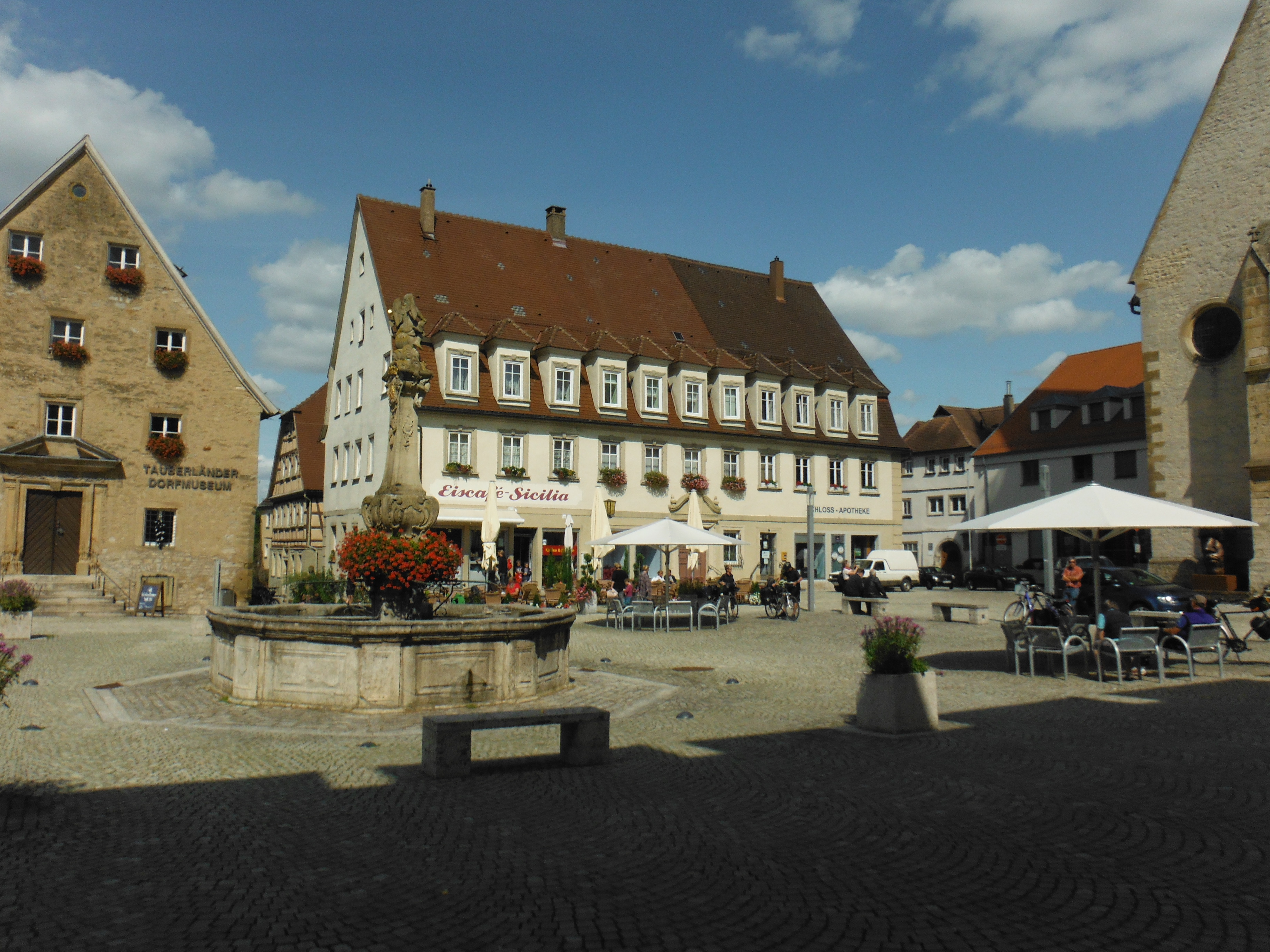 significantly, Bad Mergentheim. The secret to its fortune is in the name. The area is rich in mineral springs and was found to be particularly useful in dealing with digestive disorders. The town also boasts a medieval castle with baroque church. But significantly, it feels like a real working town. Indeed over this stretch of the cycle path one cross the border into Baden-Württemberg, a culturally different place to neighbouring Bavaria. As one pushes further along the Tauber towards the confluence with the Main at Wertheim, it becomes more industrial and less twee. It is no worse for that.
 Hence, one enters Tauberbishofsheim through a light industrial area; and whilst it is not unattractive in the centre, it feels much more lived in. There is no nearby campsite, though it is well frequented by cyclists as we discovered in the hotel in which we opted to spend the night.
Tandem Tour 2015: Regensburg to Eichstätt
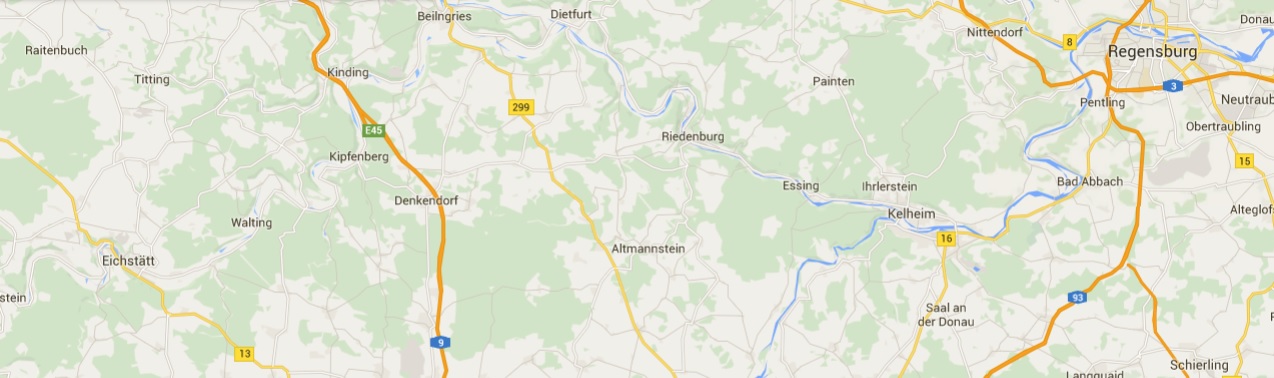 We took the train from Munich to Regensburg. The lifts at both stations are big enough to fit the loaded tandem. The signs outside the station immediately direct cyclists to the cycle path along the Danube in the first instance.
This section is picturesque, quite leafy and packed full of vertiginously perched castles and monuments. One should always be looking up as well as forward.
For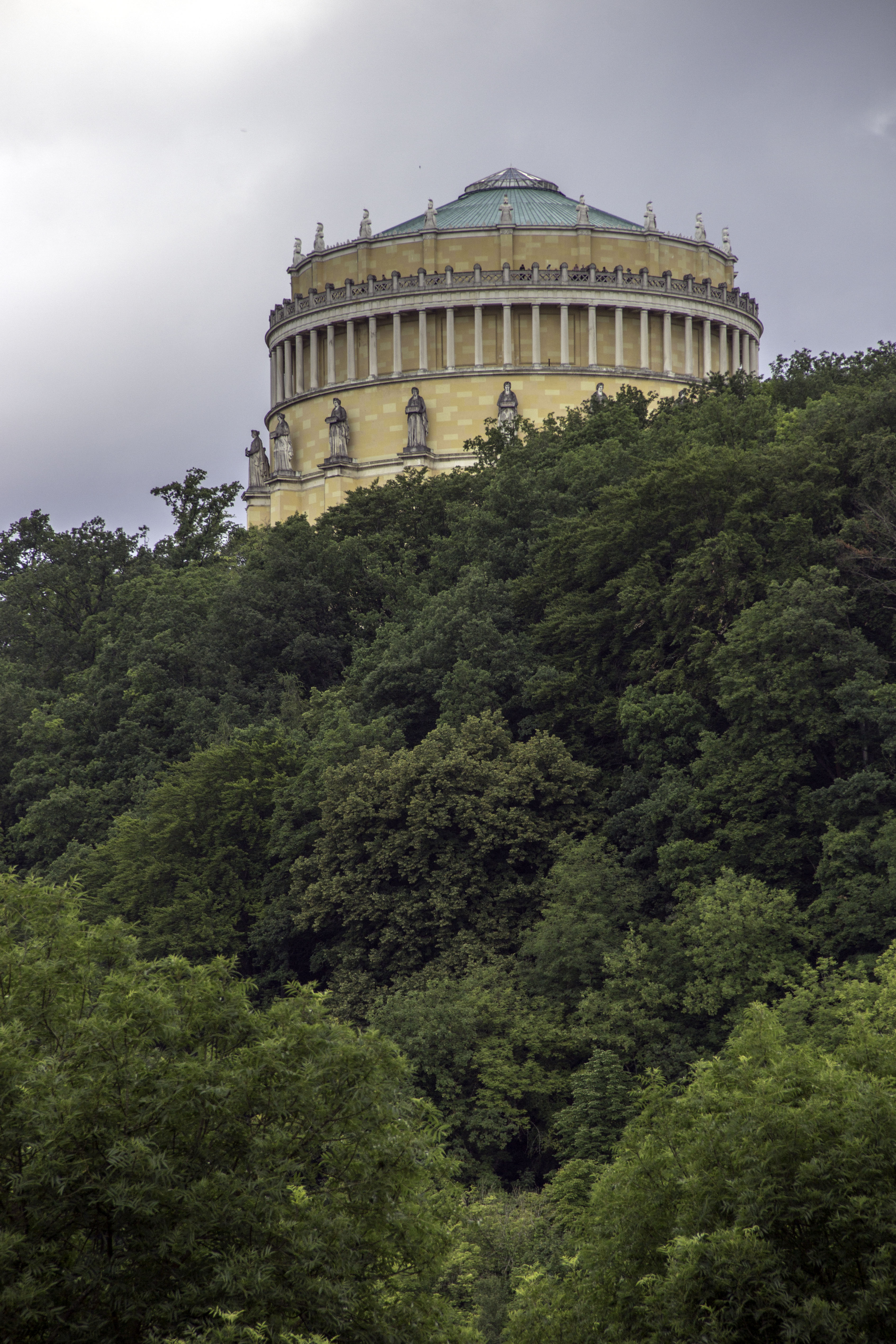 example, at Kelheim one finds the wonderfully curious Befreiungshalle (right). If my understanding is correct it is a after-the-fact monument to the defeat of Napoleon during the Befreiungskriege of 1813-15. The work on the monument itself was started in 1842 and completed in 1856 after a number of issues, not least the death of the architect/builder. It was principally funded by King Ludwig I of Bavaria. However, one should never underestimate the effect of French occupation of German lands on the country’s history. Monuments like this are not so unusual. I’ve used an image by (Wikipedia) because when we passed by it was shrouded in scaffolding.
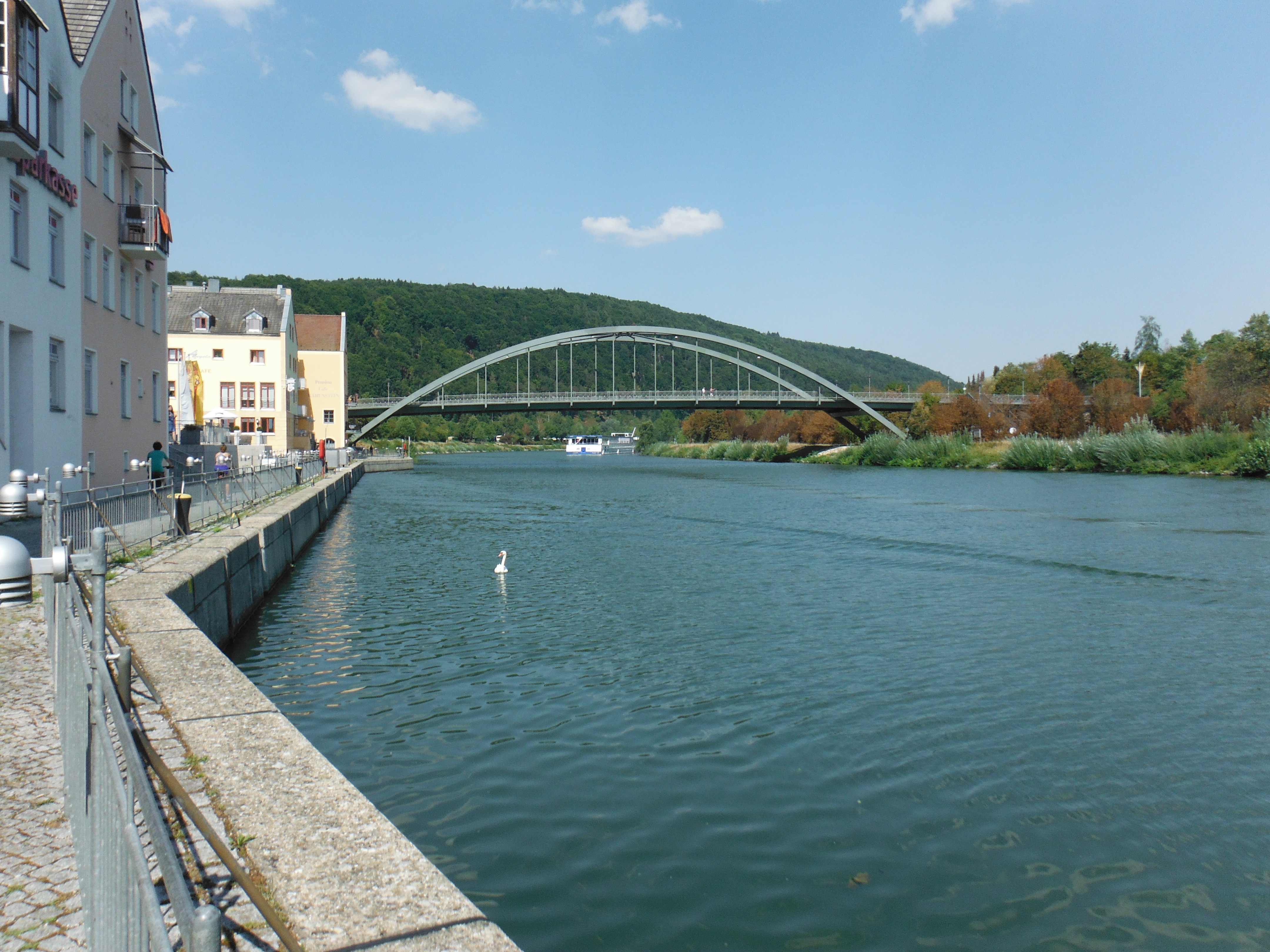 At Kelheim the Altmühl flows into the Danube. We were riding against the flow (and the wind). After camping at Kastlhof, we followed the river to Riedenburg (left) and Dietfurt. What one has to say about these places is that they are a shade generic. Dietfurt Rathaus
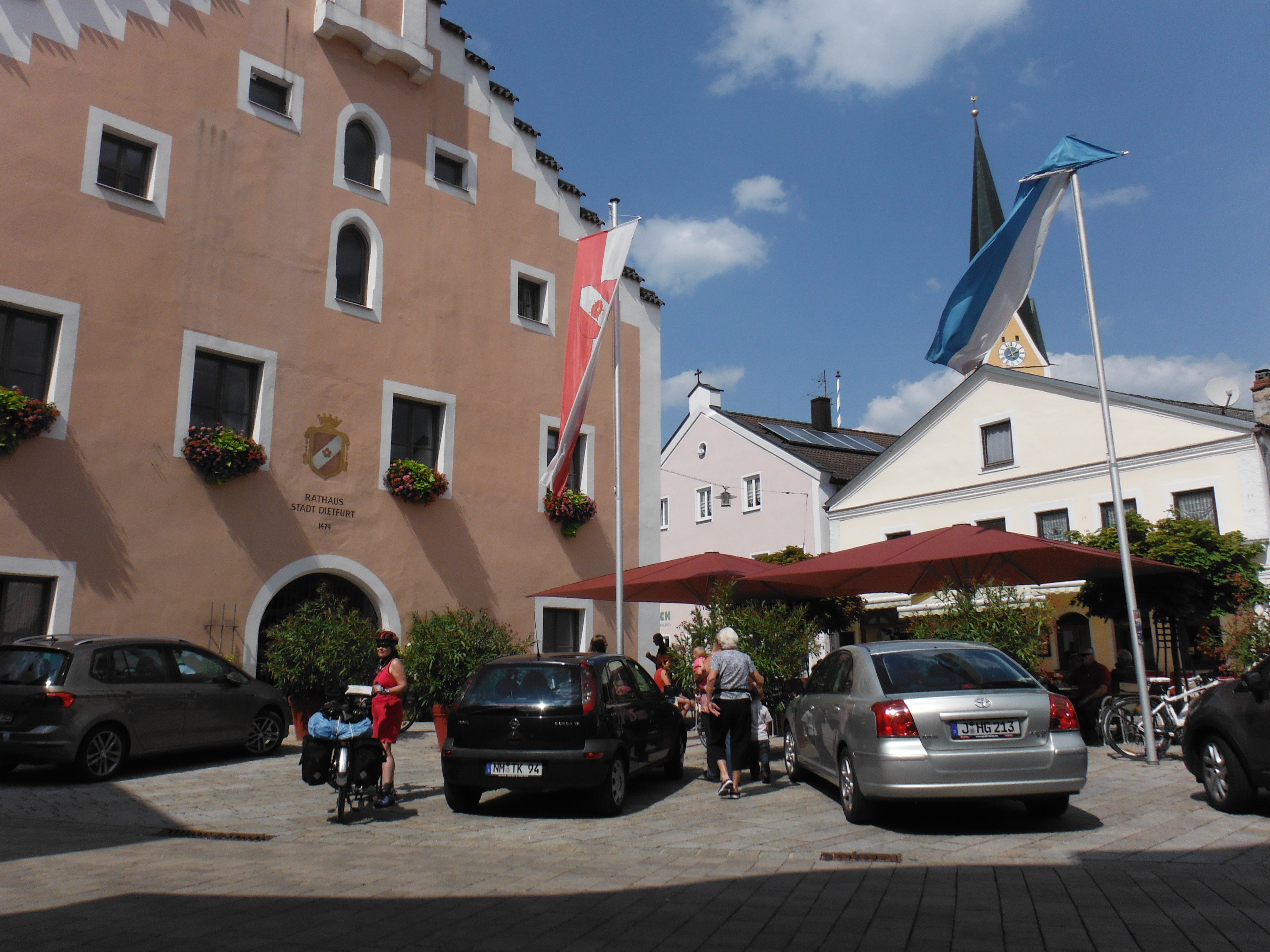 (right) is typical of the architecture of the region. And the Altmühl towns are, on the whole, very well looked after.
However, Eichstät itself is exceptional. A small town tracing its routes back to the 8th century BC with a cathedral, monestary (left) and a  catholic university is quite something to behold. I quite like the random sculptures in front of a nicely graffiti’d wall. Just a concession to demonstrate that even here, a white wall is too much to resist. The town is rather quiet in the evening out of university time.
 Be informed